Interop with Microsoft resource estimator
Having interopability with Microsoft’s open-source resource estimator is useful because it allows users more flexiblity with their Qualtran programs and allows users to verify estimates given by Qualtran’s resource estimator tooling.
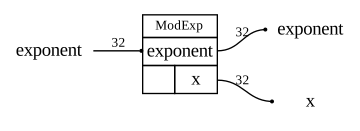
In this notebook, we will demonstrate doing resource estimation on the ModExp Bloq, the essential subroutine in Shor’s factoring algorithm.
In the next cell we have a function which takes in a Bloq and returns LogicalCounts, a python object which stores information about the logical data and gate counts. You can initialize the LogicalCounts object with a dictionary with information about your quantum algorithm. You can populate fields such as numQubits and tCount with information from a Qualtran Bloq as show below. For a more complete overview of the fields which you can specify in LogicalCounts, click here and look for the table which specifies the available functions with AccountForEstimates.
The LogicalCounts object has the key method, estimate, which returns an EstimatorResult which contains the physical resource estimates. By running the cell below, you can see a nice display of the physical resource estimates including runtime, physical qubits, and many more important resource estimates. For a more complete description of the EstimatorResult, click here.
Physical resource estimates
| Item | 0 | 1 | 2 | 3 |
|---|
| Runtime |
11 secs |
6 secs |
45 secs |
19 secs |
| rQOPS |
18.10M |
34.55M |
4.47M |
10.86M |
| Physical qubits |
404.06k |
72.42k |
402.86k |
24.90k |
Resource estimates breakdown
| Item | 0 | 1 | 2 | 3 |
|---|
| Logical algorithmic qubits |
152 |
152 |
152 |
152 |
| Algorithmic depth |
1.33M |
1.33M |
1.33M |
1.33M |
| Logical depth |
1.33M |
1.33M |
1.33M |
1.33M |
| Clock frequency |
119.05k |
227.27k |
29.41k |
71.43k |
| Number of T states |
1.33M |
1.33M |
1.33M |
1.33M |
| Number of T factories |
15 |
11 |
15 |
10 |
| Number of T factory invocations |
88.95k |
121.30k |
88.95k |
133.43k |
| Physical algorithmic qubits |
134.06k |
36.78k |
87.86k |
14.90k |
| Physical T factory qubits |
270.00k |
35.64k |
315.00k |
10.00k |
| Required logical qubit error rate |
2.47e-12 |
2.47e-12 |
2.47e-12 |
2.47e-12 |
| Required logical T state error rate |
3.75e-10 |
3.75e-10 |
3.75e-10 |
3.75e-10 |
| Number of T states per rotation |
No rotations in algorithm |
No rotations in algorithm |
No rotations in algorithm |
No rotations in algorithm |
Logical qubit parameters
| Item | 0 | 1 | 2 | 3 |
|---|
| QEC scheme |
surface_code |
surface_code |
surface_code |
surface_code |
| Code distance |
21 |
11 |
17 |
7 |
| Physical qubits |
882 |
242 |
578 |
98 |
| Logical cycle time |
8 microsecs |
4 microsecs |
34 microsecs |
14 microsecs |
| Logical qubit error rate |
3.00e-13 |
3.00e-14 |
2.08e-12 |
1.58e-14 |
| Crossing prefactor |
0.03 |
0.03 |
0.08 |
0.08 |
| Error correction threshold |
0.01 |
0.01 |
0.0015 |
0.0015 |
| Logical cycle time formula |
(4 * twoQubitGateTime + 2 * oneQubitMeasurementTime) * codeDistance |
(4 * twoQubitGateTime + 2 * oneQubitMeasurementTime) * codeDistance |
20 * oneQubitMeasurementTime * codeDistance |
20 * oneQubitMeasurementTime * codeDistance |
| Physical qubits formula |
2 * codeDistance * codeDistance |
2 * codeDistance * codeDistance |
2 * codeDistance * codeDistance |
2 * codeDistance * codeDistance |
T factory parameters
| Item | 0 | 1 | 2 | 3 |
|---|
| Physical qubits |
18.00k |
3.24k |
21.00k |
1.00k |
| Runtime |
125 microsecs |
47 microsecs |
509 microsecs |
132 microsecs |
| Number of output T states per run |
1 |
1 |
1 |
1 |
| Number of input T states per run |
270 |
15 |
25.08k |
345 |
| Distillation rounds |
2 |
1 |
3 |
2 |
| Distillation units per round |
18, 1 |
1 |
1672, 21, 1 |
23, 1 |
| Distillation units |
15-to-1 space efficient, 15-to-1 space efficient |
15-to-1 space efficient |
15-to-1 space efficient, 15-to-1 space efficient, 15-to-1 RM prep |
15-to-1 RM prep, 15-to-1 space efficient |
| Distillation code distances |
5, 19 |
9 |
1, 5, 17 |
1, 5 |
| Number of physical qubits per round |
18.00k, 14.44k |
3.24k |
20.06k, 21.00k, 17.92k |
713, 1.00k |
| Runtime per round |
26 microsecs, 99 microsecs |
47 microsecs |
5 microsecs, 130 microsecs, 374 microsecs |
2 microsecs, 130 microsecs |
| Logical T state error rate |
3.60e-10 |
5.63e-11 |
1.96e-10 |
1.71e-10 |
Pre-layout logical resources
| Item | 0 | 1 | 2 | 3 |
|---|
| Logical qubits (pre-layout) |
64 |
64 |
64 |
64 |
| T gates |
1.33M |
1.33M |
1.33M |
1.33M |
| Rotation gates |
0 |
0 |
0 |
0 |
| Rotation depth |
0 |
0 |
0 |
0 |
| CCZ gates |
0 |
0 |
0 |
0 |
| CCiX gates |
0 |
0 |
0 |
0 |
| Measurement operations |
0 |
0 |
0 |
0 |
Assumed error budget
| Item | 0 | 1 | 2 | 3 |
|---|
| Total error budget |
1.00e-3 |
1.00e-3 |
1.00e-3 |
1.00e-3 |
| Logical error probability |
5.00e-4 |
5.00e-4 |
5.00e-4 |
5.00e-4 |
| T distillation error probability |
5.00e-4 |
5.00e-4 |
5.00e-4 |
5.00e-4 |
| Rotation synthesis error probability |
0.00e0 |
0.00e0 |
0.00e0 |
0.00e0 |
Physical qubit parameters
| Item | 0 | 1 | 2 | 3 |
|---|
| Qubit name |
qubit_gate_ns_e3 |
qubit_gate_ns_e4 |
qubit_maj_ns_e4 |
qubit_maj_ns_e6 |
| Instruction set |
GateBased |
GateBased |
Majorana |
Majorana |
| Single-qubit measurement time |
100 ns |
100 ns |
100 ns |
100 ns |
| Single-qubit gate time |
50 ns |
50 ns |
N/A |
N/A |
| Two-qubit gate time |
50 ns |
50 ns |
N/A |
N/A |
| T gate time |
50 ns |
50 ns |
100 ns |
100 ns |
| Single-qubit measurement error rate |
0.001 |
0.0001 |
{'process': 0.0001, 'readout': 0.0001} |
{'process': 1e-06, 'readout': 1e-06} |
| Single-qubit error rate |
0.001 |
0.0001 |
N/A |
N/A |
| Two-qubit error rate |
0.001 |
0.0001 |
N/A |
N/A |
| T gate error rate |
0.001 |
0.0001 |
0.05 |
0.01 |
| Two-qubit measurement time |
N/A |
N/A |
100 ns |
100 ns |
| Two-qubit measurement error rate |
N/A |
N/A |
{'process': 0.0001, 'readout': 0.0001} |
{'process': 1e-06, 'readout': 1e-06} |
Constraints
| Item | 0 | 1 | 2 | 3 |
|---|
| Logical depth factor |
constraint not set |
constraint not set |
constraint not set |
constraint not set |
| Maximum number of T factories |
constraint not set |
constraint not set |
constraint not set |
constraint not set |
| Maximum runtime duration |
constraint not set |
constraint not set |
constraint not set |
constraint not set |
| Maximum number of physical qubits |
constraint not set |
constraint not set |
constraint not set |
constraint not set |
Assumptions
You can display more complex UIs on top of estimates with qsharp_widgets. For example, the code below displays a chart with information on the physical qubit counts. To learn more about using qsharp_widgets to create other informative graphics such as a Space-time diagram, click here.