
Controlled#
The controlled protocol lets you request a controlled version of a bloq: a bloq that is only active based on the status of another quantum bit or register.
A key feature of any program is the ability to do branching. That is, choosing what operations to do based on input. Controlled bloqs give the quantum programmer access to branching.
In its simplest form, a control bit is specified as an (additional) input to a bloq and the bloq is active when the control input is in the \(|1\rangle\) state. Otherwise, the bloq’s operation is not performed. Equivalently, the control bit toggles between the bloq and the Identity operation.
Control bits can be in quantum superposition. The result is a wavefunction containaing simultaneous branches where the controlled operation was performed and not performed.
from qualtran.drawing import show_bloq
from qualtran.bloqs.basic_gates import XGate

x = XGate()

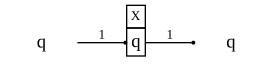
show_bloq(x)
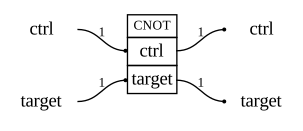
show_bloq(x.controlled())
Interface#
The method for accessing the controlled version of a bloq is calling Bloq.controlled(ctrl_spec). ctrl_spec is an instance of qualtran.CtrlSpec which specifies the condition under which the bloq is active.
CtrlSpec supports \(|1\rangle\)-state individual control bits, as well as:
‘negative’ controls where the bloq is active if the input is |0>.
integer-equality controls where an input of an arbitrary
QCDTypemust match a compile-time control value.ndarrays of control values, where the bloq is active if all inputs are active.
Multiple control registers, control values for each of which can be specified using 1-3 above.
For example:
CtrlSpec(qdtypes=QUInt(4), cvs=0b0110): Ctrl for a single register, of typeQUInt(4)and shape(), is active when the soquet of the input register takes value 6.
from qualtran import CtrlSpec, QUInt, QBit

ctrl_spec = CtrlSpec(qdtypes=QUInt(4), cvs=0b0110)
assert ctrl_spec.is_active(6)
cx = x.controlled(ctrl_spec=ctrl_spec)
show_bloq(cx, type='musical_score')

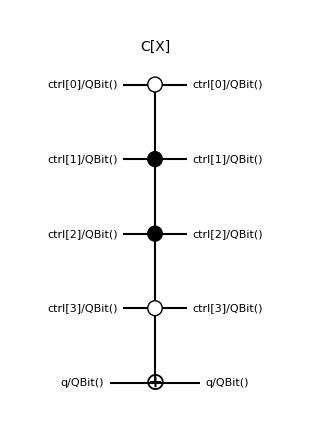
CtrlSpec(cvs=[0, 1, 1, 0]): Ctrl for a single register, of typeQBit()and shape(4,), is active when soquets of input register take values[0, 1, 1, 0].
ctrl_spec = CtrlSpec(cvs=[0, 1, 1, 0])
assert ctrl_spec.is_active([0, 1, 1, 0])
cx = x.controlled(ctrl_spec=ctrl_spec)
show_bloq(cx, type='musical_score')
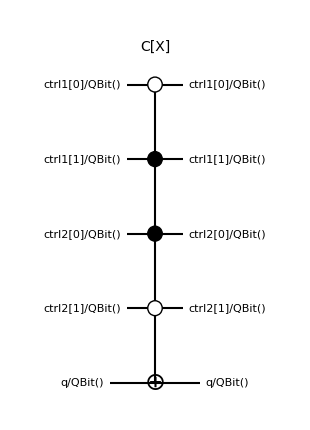
CtrlSpec(qdtypes=[QBit(), QBit()], cvs=[[0, 1], [1, 0]]).is_active([0, 1], [1, 0]): Ctrl for 2 registers, each of typeQBit()and shape(2,), is active when the soquet for each register takes values[0, 1]and[1, 0]respectively.
import numpy as np

ctrl_spec = CtrlSpec(qdtypes=[QBit(), QBit()], cvs=[[0, 1], [1, 0]])
assert ctrl_spec.is_active([0, 1], [1, 0])
cx = x.controlled(ctrl_spec=ctrl_spec)
show_bloq(cx, type='musical_score')
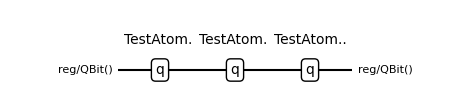
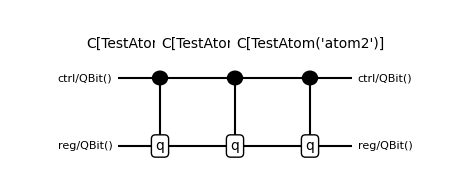
The controlled bloq is defined by its decomposition in addition to its classical and quantum simulation protocols. For a general bloq, we can provide a decomposition of its controlled version by controlling each of the subbloqs.
from qualtran.bloqs.for_testing import TestSerialCombo

serial = TestSerialCombo()
cserial = serial.controlled()
show_bloq(serial.decompose_bloq(), type='musical_score')
show_bloq(cserial.decompose_bloq(), type='musical_score')
Implementation#
Bloq authors can override Bloq.get_ctrl_system(...) to provide a custom controlled version of a bloq. Please read the docstrings for this method to understand the required return values.
We’ve already seen an example where XGate().controlled() will give the CNOT bloq.
cx = XGate().controlled()
print(cx)
CNOT
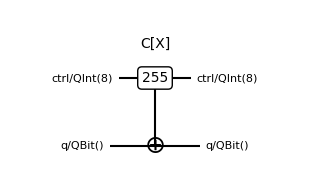
This behavior may depend on the control spec. For example, if we want to control on the input line being in the state corresponding to the unsigned integer 255, we wouldn’t get a CNOT bloq.
from qualtran import QInt
c255x = XGate().controlled(CtrlSpec(QInt(8), cvs=255))
show_bloq(c255x, type='musical_score')
print(c255x)
C[8][X]
Default Fallback#
If a bloq does not override get_ctrl_system, the system will use the qualtran.Controlled meta-bloq to wrap the original bloq
from qualtran.bloqs.for_testing import TestAtom

atom = TestAtom()
catom = atom.controlled()
catom
Controlled(subbloq=TestAtom(), ctrl_spec=CtrlSpec(qdtypes=(QBit(),), cvs=(array(1),)))
This metabloq forms an important part of the ‘controlled’ protocol. It adapts the other qualtran protocols to handle controlled versions of arbitrary bloqs. It delegates its protocols to the wrapped bloq.
Signature: That of the wrapped bloq with new registers according to
ctrl_spec.Decomposition: The controlled version of a composite bloq is formed by controlling each of the subbloqs.
Classical simulation: This uses the control spec’s activation method to check classical values. If the gate is meant to be active, the wrapped classical simulation protocol is employed. Otherwise: the input values are returned unchanged.
Tensor simulation: Currently, tensor simulation will proceed via the decomposition.
Call graph: The wrapped bloq’s call graph with controlled versions of each subbloq.
Wire_symbol: Existing registers delegate to the wrapped bloq. New control registers use the wire symbol information provided by the control spec.
Names: The wrapped bloq’s names encased with “C[…]”
Adjoint: Use the default fallback. The control lines are all symmetric.
Cirq: Use the default fallback. No translation to
cirq.ControlledOperationis done.
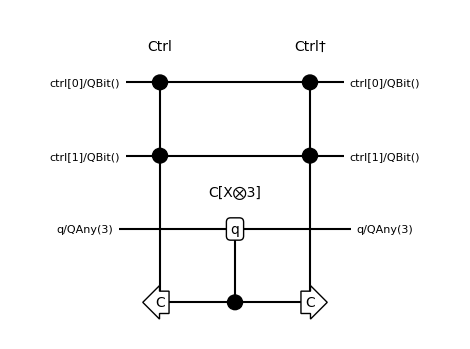
# Use the default fallback for `OnEach`; but the subbloqs all have custom
# controlled behavior:
#  C^2[X]        -> Toffoli
#  C[Split/Join] -> Split/Join
from qualtran.bloqs.basic_gates import OnEach

ccx3 = OnEach(n=3, gate=x).controlled(CtrlSpec(cvs=(1,1)))
show_bloq(ccx3.decompose_bloq(), type='musical_score')
Only bloqs with all-THRU registers can be controlled. Otherwise, it’s not clear what the equivalent “identity” operation is.