Cirq Interoperability#
Cirq is a quantum SDK for explicitly addressing physical qubits and scheduling gates. You can consider it analogous to a quantum assembly language. Qualtran provides interoperability with Cirq.
import cirq
from cirq.contrib.svg import SVGCircuit

from qualtran import Bloq, CompositeBloq, BloqBuilder, Signature
from qualtran.drawing import show_bloq
Using Cirq gates in Qualtran#
CirqGateAsBloq(gate)lets you use anycirq.Gateas if it were aqualtran.Bloq.CompositeBloq.from_cirq_circuit(circuit)converts acirq.Circuitinto an equivalentqualtran.CompositeBloq. For each gate in the circuit, we will try to translate it to a native bloq from thequaltran.bloqsstandard library; otherwise we will wrap unknown operations with theCirqGateAsBloqadapter.
CirqGateAsBloq#
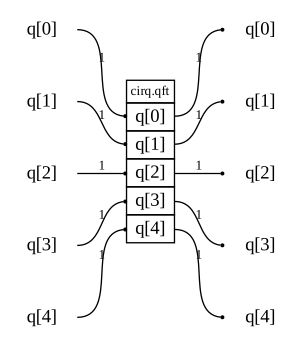
This wrapper uses the Cirq “calling convention” of one thru-register composted of a 1d array of qubits.
from qualtran.cirq_interop import CirqGateAsBloq

cgab = CirqGateAsBloq(cirq.QuantumFourierTransformGate(num_qubits=5))
print(cgab)
for reg in cgab.signature:
    print(' ', reg)
cirq.qft
  Register(name='q', dtype=QBit(), _shape=(5,), side=<Side.THRU: 3>)
show_bloq(cgab)
CompositeBloq.from_cirq_circuit#
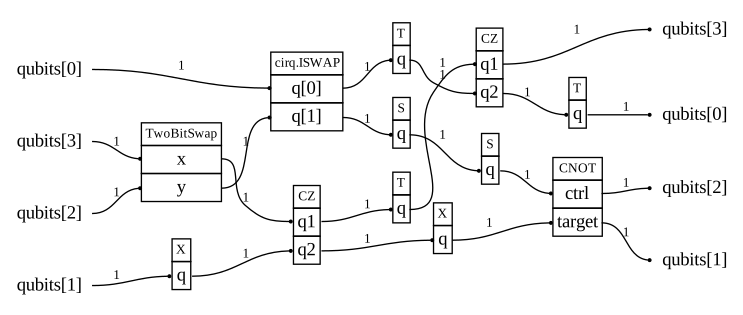
A Cirq circuit can be converted to a composite bloq by wrapping each operation with the CirqGateAsBloq wrapper.
# Make a random cirq circuit
qubits = cirq.LineQubit.range(4)
circuit = cirq.testing.random_circuit(qubits, n_moments=5, op_density=1.0, random_state=52)

# Convert to CompositeBloq
cbloq = CompositeBloq.from_cirq_circuit(circuit)
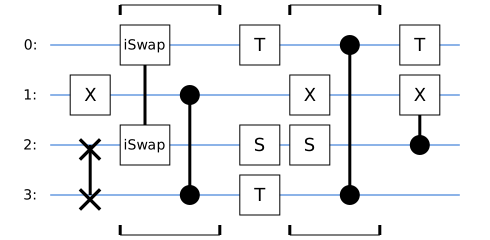
display(SVGCircuit(circuit))
show_bloq(cbloq)
Unitaries#
Both containers support numerical contraction to a dense unitary matrix. Cirq contracts operations in order. Bloqs use quimb to find a good contraction ordering and perform the contraction.
import numpy as np

bloq_unitary = cbloq.tensor_contract()
cirq_unitary = circuit.unitary(qubits)
np.testing.assert_allclose(cirq_unitary, bloq_unitary, atol=1e-8)
CompositeBloq back to cirq.Circuit#
# Note: a 1d `shape` bloq register is actually two-dimensional in cirq conversion
# because of the implicit `bitsize` dimension (which must be explicit during cirq conversion).
# CirqGateAsBloq has registers of bitsize=1 and shape=(n,); hence the list transpose below.
circuit2 = cbloq.to_cirq_circuit(cirq_quregs={'qubits':[[q] for q in qubits]}, qubit_manager=cirq.ops.SimpleQubitManager())
SVGCircuit(circuit2)
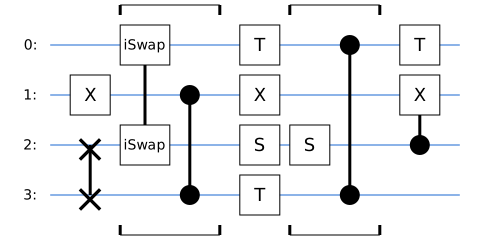
# We lose the moment structure during the roundtrip.
circuit == circuit2
False
# But the left-aligned `circuit` is recovered.
cirq.Circuit(circuit.all_operations()) == circuit2
True
Converting Bloqs to Cirq objects#
Bloq.as_cirq_opis an overridable method to declare what cirq operation corresponds to a bloq.CompositeBloq.to_cirq_circuitwill export a CompositeBloq to a cirq.FrozenCircuit. Automatically takes care of qubit allocations / deallocations with sensible defaults for initial qubits.CompositeBloq.to_cirq_circuit_and_quregswill export a CompositeBloq to a FrozenCircuit. Expects you to preallocate qubits for LEFT registers of the composite bloq and returns a dictionary mapping RIGHT registers of composite bloq to output qubit registers.BloqAsCirqGateprovides a shim for using bloqs in cirq circuits automatically.
as_cirq_op#
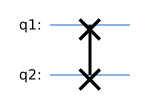
Bloqs can override as_cirq_op to optionally declare their corresponding Cirq operation. For example, the SwapTwoBits bloqs from the tutorial corresponds to cirq.SWAP.
The bloqs infrastructure will call as_cirq_op with keyword arguments mapping register names to np.ndarrays of cirq.Qid whose shape is reg.shape + (reg.bitsize,). The type alias CirqQuregT is provided for convenience.
The method must return both the Cirq operation as well as a mapping from right register names to arrays of output cirq.Qid. This is to permit the use of qubit allocation facilities in cirq.
import attrs
from typing import *

from qualtran.cirq_interop import CirqQuregT

@attrs.frozen
class SwapTwoBits(Bloq):
    @property
    def signature(self):
        return Signature.build(x=1, y=1)

    def as_cirq_op(
            self, qubit_manager, x: CirqQuregT, y: CirqQuregT
    ) -> Tuple[cirq.Operation, Dict[str, CirqQuregT]]:
        x, = x  # each is an array of length one
        y, = y
        op = cirq.SWAP(x, y)
        out_quregs = {'x': [x], 'y': [y]}
        return op, out_quregs
circuit, out_quregs = SwapTwoBits().as_composite_bloq()\
    .to_cirq_circuit_and_quregs(x=[cirq.NamedQubit('q1')], y=[cirq.NamedQubit('q2')])
SVGCircuit(circuit)
CompositeBloq.to_cirq_circuit and CompositeBloq.to_cirq_circuit_and_quregs#
A composite bloq can be turned into a circuit composed of the result of as_cirq_op for each of the subbloqs via CompositeBloq.to_cirq_circuit.
A bloq’s Signature can be passed to a helper method get_named_qubits to instantiate Cirq qubits in the correct form for input to CompositeBloq.to_cirq_circuit_and_quregs. Users can also directly call CompositeBloq.to_cirq_circuit() which allocates the named qubits for you.
from qualtran._infra.gate_with_registers import get_named_qubits

get_named_qubits(SwapTwoBits().signature.lefts())
{'x': array([cirq.NamedQubit('x')], dtype=object),
 'y': array([cirq.NamedQubit('y')], dtype=object)}
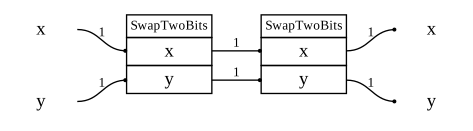
# Build a simple composite bloq
bb = BloqBuilder()
x = bb.add_register('x', 1)
y = bb.add_register('y', 1)
x, y = bb.add(SwapTwoBits(), x=x, y=y)
x, y = bb.add(SwapTwoBits(), x=x, y=y)
cbloq = bb.finalize(x=x, y=y)

# Turn it into a cirq circuit
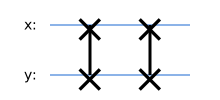
circuit = cbloq.to_cirq_circuit()

# Observe
show_bloq(cbloq)
display(SVGCircuit(circuit))
BloqAsCirqGate#
The default behavior of as_cirq_op will shim the bloq into this object which lets you use a bloq in cirq circuits.
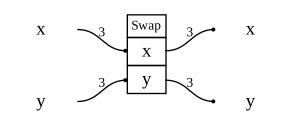
Below, we reproduce the multi-bit swap from the tutorial. This time, we do not implement as_cirq_op ourselves. This is appropriate if there isn’t an equivalent gate in Cirq, which is likely the case for high-level bloqs.
from qualtran.cirq_interop import BloqAsCirqGate, cirq_optree_to_cbloq

@attrs.frozen
class Swap(Bloq):
    n: int

    @property
    def signature(self):
        return Signature.build(x=self.n, y=self.n)

    def build_composite_bloq(
            self, bb: 'BloqBuilder', *, x: 'SoquetT', y: 'SoquetT'
    ) -> Dict[str, 'SoquetT']:
        xs = bb.split(x)
        ys = bb.split(y)
        for i in range(self.n):
            xs[i], ys[i] = bb.add(SwapTwoBits(), x=xs[i], y=ys[i])
        return {'x': bb.join(xs), 'y': bb.join(ys)}
swap = Swap(n=3)
show_bloq(swap)
show_bloq(swap.decompose_bloq())
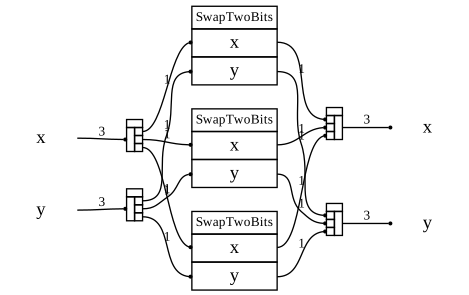
Instead, we get a BloqAsCirqGate by default.
circuit = swap.as_composite_bloq().to_cirq_circuit(
    cirq_quregs= {'x':cirq.LineQubit.range(3), 'y':cirq.LineQubit.range(100,103)}
)
(op,) = circuit.all_operations()
op
BloqAsCirqGate(Swap)(cirq.LineQubit(0), cirq.LineQubit(1), cirq.LineQubit(2), cirq.LineQubit(100), cirq.LineQubit(101), cirq.LineQubit(102))
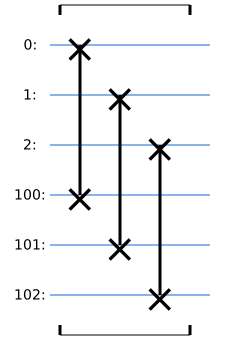
This wrapper can delegate cirq.decompose_once calls to the bloq’s decomposition. If the subbloqs in the decomposition have native as_cirq_op operations, then we successfully have a standard Cirq circuit.
swap_decomp_circuit = cirq.Circuit(cirq.decompose_once(op))
print(repr(swap_decomp_circuit))
cirq.Circuit([
    cirq.Moment(
        cirq.SWAP(cirq.LineQubit(0), cirq.LineQubit(100)),
        cirq.SWAP(cirq.LineQubit(1), cirq.LineQubit(101)),
        cirq.SWAP(cirq.LineQubit(2), cirq.LineQubit(102)),
    ),
])
SVGCircuit(swap_decomp_circuit)
Allocation and de-allocation#
Cirq conversion can allocate and deallocate qubits with the help of qubit allocation tools in cirq. As an example, we look at the MultiAnd bloq. Behind the scenes, this uses the default BloqAsCirqGate shim which will allocate the target and junk right-only registers automatically.
from qualtran.bloqs.mcmt import MultiAnd

multi_and = MultiAnd(cvs=(1, 1, 1, 1))
Our input Cirq qubit registers include just the control qubits.
cirq_quregs = get_named_qubits(multi_and.signature.lefts())
cirq_quregs
{'ctrl': array([[cirq.NamedQubit('ctrl[0]')],
        [cirq.NamedQubit('ctrl[1]')],
        [cirq.NamedQubit('ctrl[2]')],
        [cirq.NamedQubit('ctrl[3]')]], dtype=object)}
multi_and_circuit, out_quregs = multi_and.decompose_bloq().to_cirq_circuit_and_quregs(**cirq_quregs)
SVGCircuit(multi_and_circuit)
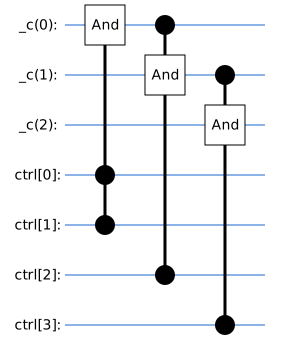
The second return value of as_cirq_op and to_cirq_circuit_and_quregs is the output cirq qubit registers that we can use to identify allocated qubits.
# Note the new precense of `junk` and `target` entries.
out_quregs
{'ctrl': array([[cirq.NamedQubit('ctrl[0]')],
        [cirq.NamedQubit('ctrl[1]')],
        [cirq.NamedQubit('ctrl[2]')],
        [cirq.NamedQubit('ctrl[3]')]], dtype=object),
 'junk': array([[cirq.ops.CleanQubit(0)],
        [cirq.ops.CleanQubit(1)]], dtype=object),
 'target': array([cirq.ops.CleanQubit(2)], dtype=object)}
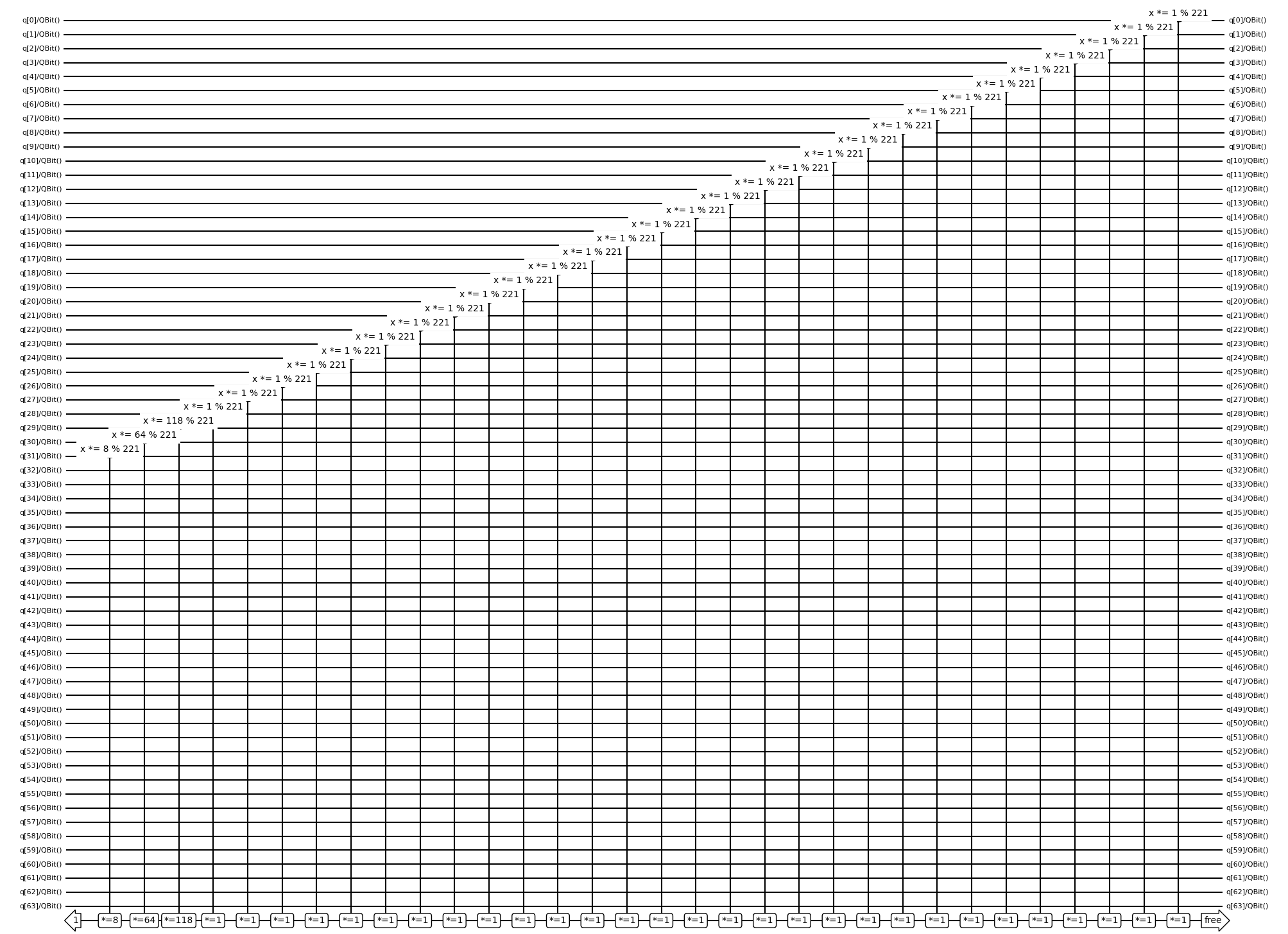
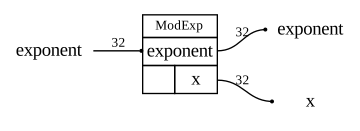
Test Bloqs -> Cirq -> Bloqs roundtrip using ModExp#
from qualtran.bloqs.cryptography.rsa import ModExp
from qualtran.drawing import show_bloq
from qualtran.drawing import get_musical_score_data, draw_musical_score
N = 13*17
n = int(np.ceil(np.log2(N)))
g = 8
mod_exp = ModExp(base=g, mod=N, exp_bitsize=32, x_bitsize=32)
show_bloq(mod_exp)
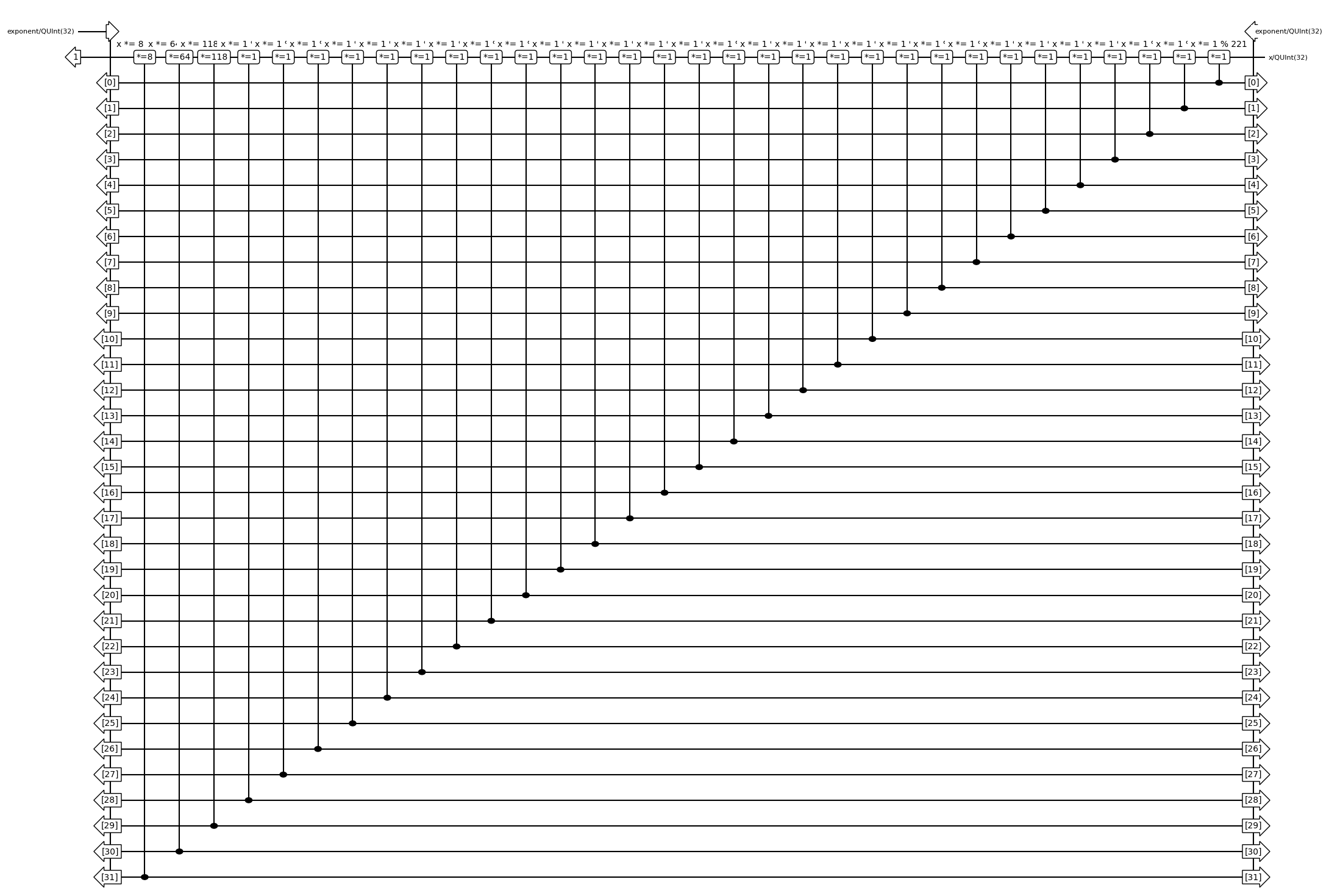
cbloq = mod_exp.decompose_bloq()
fig, ax = draw_musical_score(get_musical_score_data(cbloq))
fig.set_size_inches(24, 15)
in_quregs = {'exponent': np.array(cirq.LineQubit.range(32))}

op, out_quregs = BloqAsCirqGate.bloq_on(mod_exp, cirq_quregs=in_quregs, qubit_manager=cirq.ops.SimpleQubitManager())

# 1. Decompose using cirq.decompose_once(op) and then convert back into a CompositeBloq.
decomposed_circuit = cirq.Circuit(cirq.decompose_once(op))
cbloq = cirq_optree_to_cbloq(decomposed_circuit, signature=mod_exp.signature, in_quregs=in_quregs, out_quregs=out_quregs)
fig, ax = draw_musical_score(get_musical_score_data(cbloq))
fig.set_size_inches(24, 15)
# 2. Ensure that Bloq -> BloqAsCirqGate -> CirqGateAsBloq.decompose_bloq() roundtrip works as expected.
# This makes sure no information is lost when converting from Bloqs -> Cirq -> Bloqs.
bloq = CirqGateAsBloq(BloqAsCirqGate(mod_exp))
cbloq = CirqGateAsBloq(op.gate).decompose_bloq()
fig, ax = draw_musical_score(get_musical_score_data(cbloq))
fig.set_size_inches(24, 15)