
Adjoint#
The adjoint protocol lets you request the adjoint of a bloq.
Namely, if a given bloq represents a linear operator, this protocol returns a bloq representing the Hermitian adjoint (“Hermitian conjugate” or “adjoint”) of the original operator. When the operators are represented by matrices, the adjoint is the conjugate transpose.
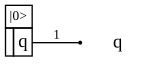
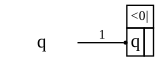
Below we see that \(\left(|0\rangle\right)^\dagger = \langle 0|\).
Note: in mathematical notation, we apply operators from right to left. In Qualtran drawings (inspired by tensor networks and quantum circuits), the order goes from left to right.
from qualtran.drawing import show_bloq
from qualtran.bloqs.basic_gates import ZeroState

print(ZeroState())
show_bloq(ZeroState())
print(ZeroState().adjoint())
show_bloq(ZeroState().adjoint())
|0>
<0|
Interface#
The method for accessing the adjoint of a bloq is calling the Bloq.adjoint() method on the bloq.
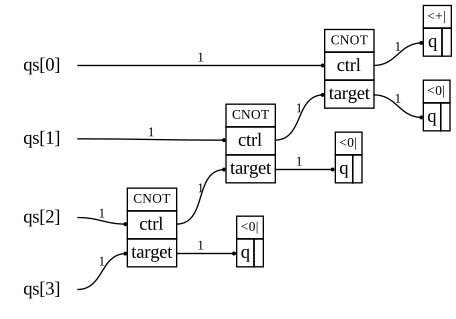
Of particular note is the CompositeBloq.adjoint() override which codifies the “anti-distributivity” of the adjoint: \((AB)^\dagger = B^\dagger A^\dagger\).
The adjoint of a composite bloq reverses the direction of the flow of data (i.e. it reverses the order of operations) and uses the adjoint of each sub-bloq.
import numpy as np

from qualtran import BloqBuilder
from qualtran.bloqs.basic_gates import ZeroState, PlusState, CNOT

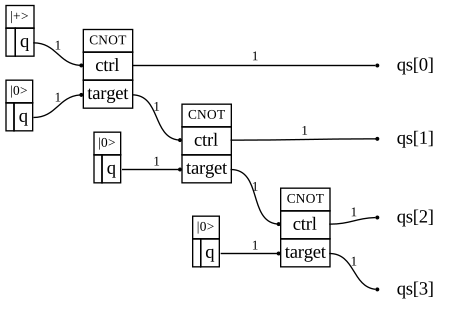
# Construct a bell state by doing a ladder of CNOTs
bb = BloqBuilder()
q0 = bb.add(PlusState())

src_q = q0  # current wire
qvars = []  # track output wires
for _ in range(3):
    next_q = bb.add(ZeroState())
    src_q, next_q = bb.add(CNOT(), ctrl=src_q, target=next_q)

    qvars.append(src_q)
    src_q = next_q

qvars.append(src_q)
bell_cbloq = bb.finalize(qs=np.array(qvars))
show_bloq(bell_cbloq)
# Take the adjoint of a composite bloq
show_bloq(bell_cbloq.adjoint())
Implementation#
Bloq authors can override Bloq.adjoint() in certain circumstances.
If the bloq is self-adjoint. For example, many common gates like
CNOTandXGateare self-adjoint, i.e. \(U=U^\dagger\).If there is an optimized compilation for the adjoint. For example,
Andhas a special construction that only works when un-computing.
from qualtran.bloqs.basic_gates import CNOT, XGate

# Examples of self-adjoint bloqs.
print('X == X^dag:      ', XGate() == XGate().adjoint())
print('CNOT == CNOT^dag:', CNOT() == CNOT().adjoint())
X == X^dag:       True
CNOT == CNOT^dag: True
# A bloq with a special construction (and reduced cost) for its adjoint.

from qualtran.bloqs.mcmt import And
from qualtran.drawing import show_counts_sigma

_, forward_costs = And().call_graph()
_, backward_costs = And().adjoint().call_graph()
show_counts_sigma(forward_costs)
show_counts_sigma(backward_costs)
Counts totals:
And: 1
Counts totals:
And†: 1
Default Fallback#
If a bloq does not override .adjoint(), the system will use the qualtran.Adjoint meta-bloq to wrap the original bloq.
from qualtran.bloqs.for_testing import TestSerialCombo

bloq = TestSerialCombo()
bloq.adjoint()
Adjoint(subbloq=TestSerialCombo())
This metabloq forms an important part of the adjoint protocol. It adapts the other qualtran protocols to resepct the adjoint-edness of the wrapped subbloq.
The Adjoint bloq generally delegates all of its protocols to self.subbloq:
Signature: The signature is the adjoint of
subbloqs’s signature. Namely, LEFT and RIGHT registers are swapped.Decomposition: The decomposition is the adjoint of
subbloq’s decomposition. Namely, the order of operations in the resultantCompositeBloqis reversed and each bloq is replaced with its adjoint.Adjoint: The adjoint of an
Adjointbloq is the subbloq itself.Call graph: The call graph is the subbloq’s call graph, but each bloq is replaced with its adjoint.
Cirq Interop: The default
Bloqimplementation is used, which goes viaBloqAsCirqGateas usual.Wire Symbol: The wire symbols are the adjoint of
subbloq’s wire symbols. Namely, left- and right-oriented symbols are flipped.Names: The string names / labels are that of the
subbloqwith a dagger symbol appended.
Some protocols are impossible to delegate specialized implementations. The Adjoint bloq
supports the following protocols with “decompose-only” implementations. This means we always
go via the bloq’s decomposition instead of preferring specialized implementations provided by
the bloq author. If a specialized implementation of these protocols are required or you
are trying to represent an adjoint bloq without a decomposition and need to support these
protocols, you cannot use the default fallback method.
Classical simulation is “decompose-only”. It is impossible to invert a generic python function.
Tensor simulation is “decompose-only” due to technical details around the Quimb interop.
# The decomposition is the adjoint of the wrapped bloq's decomposition
show_bloq(bloq.decompose_bloq())
show_bloq(bloq.adjoint().decompose_bloq())


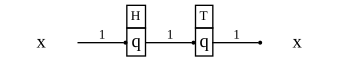
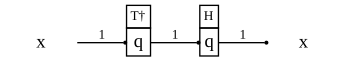
In the next cell, we write a quick block that has a non-trivial adjoint. We’ll take a look at its decomposition and tensor contraction.
from functools import cached_property
from typing import *

from qualtran import BloqBuilder, Bloq, Signature, SoquetT
from qualtran.bloqs.basic_gates import TGate, Hadamard

class TStateMaker(Bloq):
    @cached_property
    def signature(self) -> 'Signature':
        return Signature.build(x=1)

    def build_composite_bloq(self, bb: 'BloqBuilder', x: 'SoquetT') -> Dict[str, 'SoquetT']:
        x = bb.add(Hadamard(), q=x)
        x = bb.add(TGate(), q=x)
        return {'x': x}

show_bloq(TStateMaker().decompose_bloq())
# Use the default fallback for `.adjoint()`
show_bloq(TStateMaker().adjoint().decompose_bloq())
unitary = TStateMaker().tensor_contract()
adj_unitary = TStateMaker().adjoint().tensor_contract()
np.testing.assert_allclose(unitary.conj().T, adj_unitary)
print("Check!")
Check!
Additional Functionality#
Signature, Register, and qualtran.drawing.WireSymbol also provide an adjoint method which returns a version of the object with “right” and “left” reversed.