
Cross-checking Classical Simulation#
In this notebook, we will demonstrate how classical reversible logic bloqs can combine the quantum simulation and classical simulation protocols to cross check their logic.
We’ll use a provided library function to wrap a bloq in allocations and de-allocations
following the bloq’s classical logic so that when we contract the resultant tensor network
we get a value of 1 (corresponding to a normalized, unitary universe) if everything
checks out.
The function flank_with_classical_vectors will set up the CompositeBloq we need.
from qualtran.drawing import show_bloq
from qualtran.simulation.xcheck_classical_quimb import flank_with_classical_vectors

import numpy as np
XGate#
The X gate flips a given bit.
from qualtran.bloqs.basic_gates import XGate
x = XGate()
If we start in the 0 basis state, we better end up in the 1 basis state.
flank_wht_classical_vectors will use the classical simulation protocol to determine
the correct output state given the provided input state, and the assert tensor_contract()
will use the quantum simulation (tensor network) protocol to check if the input/output
pair is valid for the bloq.
x_tt = flank_with_classical_vectors(x, {'q': 0})

assert x_tt.tensor_contract() == 1.0
show_bloq(x_tt, type='musical_score')
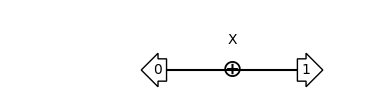
flank_with_classical_vectors will use the classical simulation protocol to determine the correct output values. We can override them with our own. Below, we make a CompositeBloq where the inputs and outputs are both the 0 vector. This doesn’t match the expected behavior of the X gate, so the tensor network contracts to zero.
result = flank_with_classical_vectors(x, in_vals={'q':0}, out_vals={'q': 0}).tensor_contract()
if result == 0.0:
    print('Tensor contracted to 0. The universe has been annihilated.')
Tensor contracted to 0. The universe has been annihilated.
CNOT#
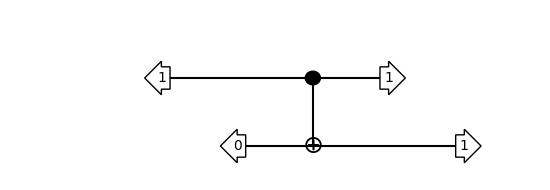
We can check other bloqs that support both classical simulation and quantum simulation. In this notebook, we’ve hardcoded some input values but you could try random inputs or use itertools.product to check all possible inputs.
from qualtran.bloqs.basic_gates import CNOT
cnot = CNOT()
cnot_tt = flank_with_classical_vectors(cnot, {'ctrl': 1, 'target': 0})

assert cnot_tt.tensor_contract() == 1.0
show_bloq(cnot_tt, type='musical_score')
Toffoli#
from qualtran.bloqs.basic_gates import Toffoli
tof = Toffoli()
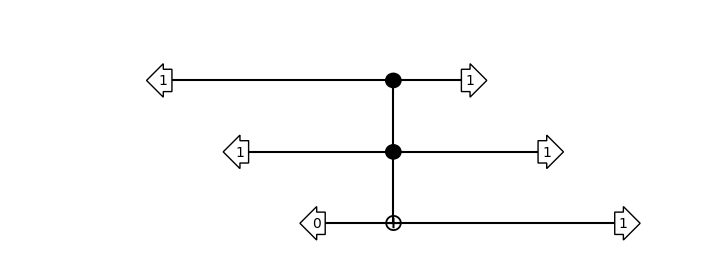
tof_tt = flank_with_classical_vectors(tof, {'ctrl': [1, 1], 'target': 0})

assert tof_tt.tensor_contract() == 1.0
show_bloq(tof_tt, type='musical_score')
Add#
from qualtran import QUInt
from qualtran.bloqs.arithmetic import Add
add = Add(QUInt(bitsize=5))
add_tt = flank_with_classical_vectors(add, {'a': 2, 'b': 3})
show_bloq(add_tt, type='musical_score')
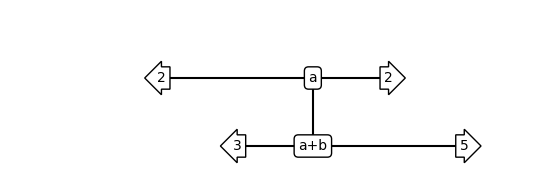
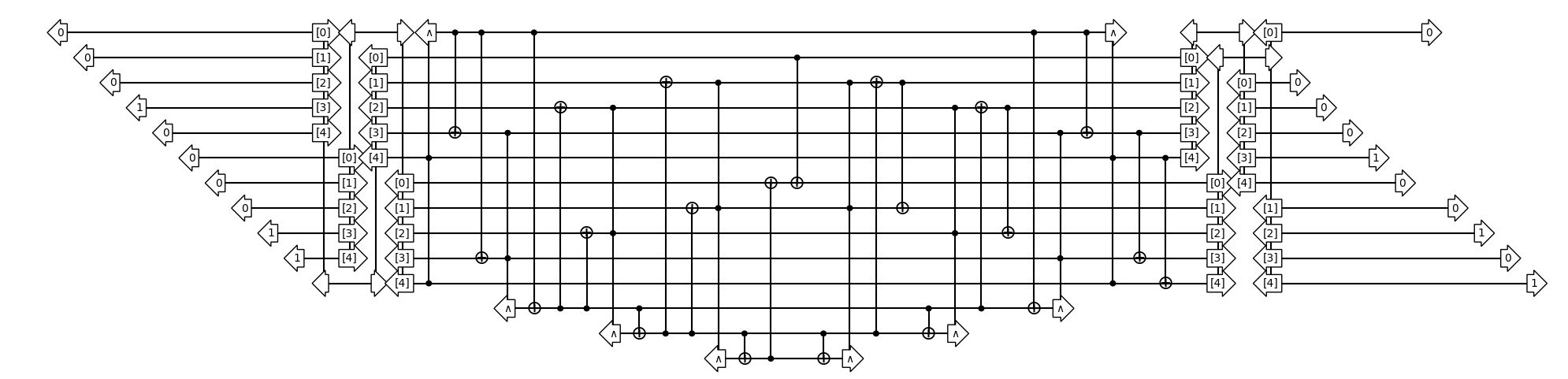
Since Add is composed of other bloqs, we can contract the factorized network that comes from the “flattened” circuit.
add_flat = add_tt.as_composite_bloq().flatten()

from qualtran.drawing import get_musical_score_data, draw_musical_score
draw_musical_score(get_musical_score_data(add_flat), max_width=20, max_height=100)
(<Figure size 2000x491.525 with 1 Axes>, <Axes: >)
np.testing.assert_allclose(add_tt.tensor_contract(), 1.0)
np.testing.assert_allclose(add_flat.tensor_contract(), 1.0)
Large bitsize#
Since we’re using Quimb to find an efficient contraction ordering, we can handle large-width, bounded-depth tensor networks.
add_large = Add(QUInt(bitsize=32))
add_large_tt = flank_with_classical_vectors(add_large, {'a': 5555, 'b': 6666})
add_large_flat = add_large_tt.flatten()

from qualtran.simulation.tensor import cbloq_to_quimb
tn = cbloq_to_quimb(add_large_flat)

print(f"We only use {tn.contraction_width()} qubit's worth of RAM for a {add_large.signature.n_qubits()}-qubit gate.")
tn.contract()
We only use 5.0 qubit's worth of RAM for a 64-qubit gate.
1.0