Bloqs Tutorial#
Qualtran lets you represent high-level quantum programs and subroutines as a hierarchical
collection of Python objects. The main interface is the Bloq abstract base class.
import abc
from typing import *


class Bloq(metaclass=abc.ABCMeta):
    ...
We use a graph-like container to wire up collections of bloqs to define new bloqs.
By the end of this tutorial, you should understand how to declare bloqs, wire them up, use named registers, use high-bitsize registers, use ‘bookkeeping’ operations to split and join wires, represent allocations as operations in the graph, and use linear logic to prevent violations of the no cloning theorem.
Basics#
There are two important flavors of implementations of the Bloq interface. The first flavor
consists of bloqs implemented by you, the user-developer to express quantum operations of
interest. For example:
class ShorsAlgorithm(Bloq):
    ...
The other important Bloq subclass is CompositeBloq, which is a container type for a
collection of sub-bloqs. We’ll investigate this class more later. First, let’s define a
bloq for a simple quantum operation: the controlled-not (CNOT).
class CNOT(Bloq):
    ...
There is only one mandatory method we must implement to have a well-formed Bloq. There
are many other methods we can optionally implement to encode more information about the
bloq, which we will add as we go along.
The mandatory method is the Bloq.signature property. This declares what the inputs and
outputs are for our bloq, and is a list of registers. A register has a name and quantum-type
information. By default, a register declares both an input and an output allowing quantum
data to pass through it, like the “control” register below. We call these THRU registers.
The Bloq.signature property can be thought of as analogous
to the function signature in ordinary programming. You can think of a bloq
with just this property implemented like a function
declarations in a C header (*.h) file.
from qualtran import Register, QBit

Register('control', QBit())
Register(name='control', dtype=QBit(), _shape=(), side=<Side.THRU: 3>)
The above declares a register named “control” with a size of 1. We’ll return this as well
as a register for the “target” input/output of the CNOT bloq wrapped in the Signature
container.
attrs.frozen annotation removes some of the boilerplate to write an immutable Python class with a pre-defined set of attributes.import attrs
from qualtran import Bloq, Signature
@attrs.frozen
class CNOT(Bloq):
@property
def signature(self):
return Signature([
Register('control', QBit()),
Register('target', QBit()),
])
We now have a well-formed bloq. We can instantiate it and visualize it.
from qualtran.drawing import show_bloq

cnot = CNOT()
show_bloq(cnot)
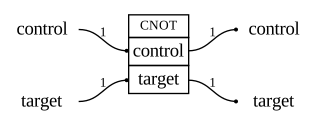
This is the absolute minimum amount of information needed to define a Bloq: a name (i.e.
the class name) and a signature property.
cirq.Gate to be analogous to a Bloq with one register named “qubits” of size n. In
fact, CirqGateAsBloq lets you wrap any Cirq gate in
this way.Decomposing Bloqs#
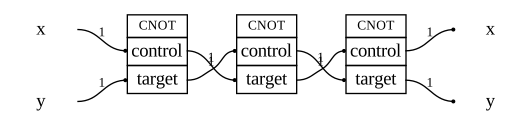
As you can probably guess, such a simple block-box model of an operation has limited utility. We now turn our attention to a second bloq: SWAP – which we will define in terms of its decomposition into three CNOTs.
class SwapTwoBits(Bloq):
    ...
As before, we must define the function signature by naming and sizing the registers on
which it operates. We’ll implement a bloq that swaps two (qu)bits. We’ll name the arguments
x and y, but you have some creative freedom with these choices.
name and bitsize
attributes for our registers. The other two attributes are for more advanced usage and
will be covered later. In simple cases, we could use the convenience method
Signature.build(x=1, y=1) for the same object below.class SwapTwoBits(Bloq):
@property
def signature(self):
return Signature([
Register('x', QBit()),
Register('y', QBit()),
])
Now, for the moment you’ve been waiting for. We can define the implementation of SWAP in terms
of sub-operations. Bloq.decompose_bloq() will decompose a bloq into its component parts.
The return type of this operation is CompositeBloq – our bloq container type which itself
follows the Bloq interface.
Instead of overriding decompose_bloq() directly, we override build_composite_bloq, which
makes it easier for you, the user-developer, to write decompositions.
from qualtran import BloqBuilder
class SwapTwoBits(Bloq):
...
def build_composite_bloq(self, bb: BloqBuilder, *, x, y):
...
The bloqs infrastructure will pass in keyword arguments for each of the input registers,
here x and y. I stress that these names must match the names of the registers declared
in the .signatures property. The infrastructure also passes in a BloqBuilder
which is what you will use to add suboperations to the composite bloq storing your
decomposition.
We use bb.add(...) to add sub-operations. For our swap operation, we will need to call
add three times for each of the CNOTs. The signature is: bb.add(bloq, **bloq_args) where
the first argument is an instantiation of the bloq we want to add, and then keyword arguments
providing the input quantum variables. This call will return quantum variables representing
the outputs of the operation that are suitable for using as inputs to subsequent operations.
The method returns a dictionary mapping (output) register names to the final quantum variables.
class SwapTwoBits(Bloq):
    @property
    def signature(self):
        return Signature([
            Register('x', QBit()),
            Register('y', QBit()),
        ])
def build_composite_bloq(self, bb: BloqBuilder, *, x, y):
x, y = bb.add(CNOT(), control=x, target=y)
y, x = bb.add(CNOT(), control=y, target=x)
x, y = bb.add(CNOT(), control=x, target=y)
return {'x': x, 'y': y}
Note that each CNOT operation takes two arguments named “control” and “target” and returns
two quantum variables which are ordered according to the ordering of the registers
in CNOT.signature (so in this case: control, target).
Let’s see what this looks like.
swap = SwapTwoBits()
show_bloq(swap)
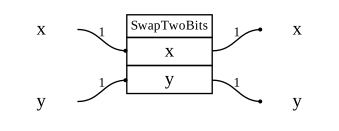
Wait! This is still just a two-bit black box! I thought we defined the bloq by its decomposition.
The Bloq object always represents the atomic operation and CompositeBloq always represents
a collection of sub-operations. We have to explicitly request the decomposition if that’s
what we want to visualize.
show_bloq(swap.decompose_bloq())
Using BloqBuilder directly#
You can build a standalone CompositeBloq (i.e. not as part of the decomposition of
another bloq) as well. This can come in handy for testing or prototyping. Simply
instantiate a BloqBuilder. You need to manually
manage your registers with bb.add_register(...) and you must finish your building session
by calling bb.finalize(...) to freeze your composite-bloq-under-construction into an
immutable CompositeBloq.
bb = BloqBuilder()
x = bb.add_register('x', 1)
y = bb.add_register('y', 1)
x, y = bb.add(CNOT(), control=x, target=y)
y, x = bb.add(CNOT(), control=y, target=x)
x, y = bb.add(CNOT(), control=x, target=y)
cbloq = bb.finalize(x=x, y=y)
show_bloq(cbloq)
Quantum variables and Soquets.#
What are the types of x and y? They represent quantum variables used to “wire up” sub
operations by providing them as inputs and receiving them as outputs during calls to bb.add.
cirq.Qubits. Whereas a cirq.Circuit has a fixed pool of qubits
on which many operations act, these quantum variables follow different rules — read on!The rules of quantum mechanics makes these quantum variables behave very differently than normal variables. The most salient rules are the no-cloning theorem and its dual, the no-deleting theorem. In the parlance of programming language research, our variables follow “linear logic”. A linear variable must be used once and only once.
The following snippets show improper use of our quantum variables. Luckily, the bloq builder will raise an error if the rules of quantum mechanics are not followed!
from qualtran import BloqError

bb = BloqBuilder()
x = bb.add_register('x', 1)
y = bb.add_register('y', 1)

try:
    _ = bb.add(CNOT(), control=x, target=x)
except BloqError as e:
    print("Can't use a variable as both control and target!")
    print(e)
Can't use a variable as both control and target!
LeftDangle.x is not an available Soquet for `CNOT.target`.
bb = BloqBuilder()
x = bb.add_register('x', 1)
y = bb.add_register('y', 1)
x2, y2 = bb.add(CNOT(), control=x, target=y)

try:
    x3, y3 = bb.add(CNOT(), control=x, target=y)
except BloqError as e:
    print("`x` and `y` were consumed by the first call to `add`.")
    print("Returned quantum variables are *new, immutable* variables that you use")
    print("in subsequent operations")
    print(e)
`x` and `y` were consumed by the first call to `add`.
Returned quantum variables are *new, immutable* variables that you use
in subsequent operations
LeftDangle.x is not an available Soquet for `CNOT.control`.
bb = BloqBuilder()
x = bb.add_register('x', 1)
y = bb.add_register('y', 1)

# The following line turns on the additional checks needed to
# raise an exception in this case:
bb.add_register_allowed = False

x2, y2 = bb.add(CNOT(), control=x, target=y)
x3, y3 = bb.add(CNOT(), control=x2, target=y2)

try:
    bb.finalize(x=x3)
except BloqError as e:
    print("Any unused variables must be 'passed on' to `finalize` to be outputs.")
    print(e)
Any unused variables must be 'passed on' to `finalize` to be outputs.
Finalizing requires a Soquet named `y`.
The actual Python type of these objects is Soquet, which you will see in type annotations,
but you should never instantiate a Soquet directly, nor should you use or set its attributes.
Soquets should be constructed and managed by BloqBuilder and other infrastructure.
BloqInstance. This simple wrapper
lets us distinguish between two instances of e.g. a CNOT bloq. Usually we want value
equality semantics between bloqs.Larger registers#
Our two bloqs have still been operating at the level of individual bits. We now consider
a general swap between two n-sized registers.
n: int line means our class has one attribute named n of type int. The attrs annotation will automatically generate an __init__ function.from qualtran import QAny
@attrs.frozen
class Swap(Bloq):
n: int
@property
def signature(self):
return Signature([
Register('x', QAny(bitsize=self.n)),
Register('y', QAny(bitsize=self.n)),
])
Note that our bloq now has an attrs attribute n that lets us configure the exact parameters
of the bloq without defining a new class. This is analogous to a template parameter in C++,
for example. Bloqs should be immutable and hashable.
assert Swap(5) == Swap(5)
assert Swap(5) != Swap(6)
from qualtran import SoquetT

@attrs.frozen
class Swap(Bloq):
    n: int

    @property
    def signature(self):
        return Signature.build(x=self.n, y=self.n)

    def build_composite_bloq(
            self, bb: BloqBuilder, *, x: SoquetT, y: SoquetT
    ) -> Dict[str, SoquetT]:
        # THIS WON'T ACTUALLY WORK! Read on.
        for i in range(self.n):
            x[i], y[i] = bb.add(SwapTwoBits(), x=x[i], y=y[i])
        return {'x': x, 'y': y}
For our first attempt, we will straightforwardly decompose our swap between two n-bit registers into n swaps over each bit in the two registers. There’s a note that this won’t actually work. Let’s see what happens.
show_bloq(Swap(n=5))
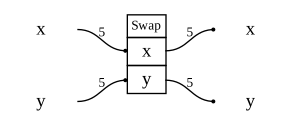
That looks fine… In fact: you can see a useful property of bloqs. Instead of representing each qubit as its own quantum variable, the size of our register is just a property annotated on the graph. We can make it arbitrarily large with no performance penalty
show_bloq(Swap(n=10_000))
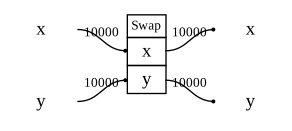
The problem occurs when we decompose our bloq.
import traceback

try:
    cbloq = Swap(n=5).decompose_bloq()
except TypeError as e:
    print(traceback.format_exc())
Traceback (most recent call last):
  File "/tmp/ipykernel_835779/2679143270.py", line 4, in <module>
    cbloq = Swap(n=5).decompose_bloq()
            ^^^^^^^^^^^^^^^^^^^^^^^^^^
  File "/usr/local/google/home/mpharrigan/qualtran/qualtran/qualtran/_infra/bloq.py", line 163, in decompose_bloq
    return _decompose_from_build_composite_bloq(self)
           ^^^^^^^^^^^^^^^^^^^^^^^^^^^^^^^^^^^^^^^^^^
  File "/usr/local/google/home/mpharrigan/qualtran/qualtran/qualtran/_infra/bloq.py", line 71, in _decompose_from_build_composite_bloq
    out_soqs = bloq.build_composite_bloq(bb=bb, **initial_soqs)
               ^^^^^^^^^^^^^^^^^^^^^^^^^^^^^^^^^^^^^^^^^^^^^^^^
  File "/tmp/ipykernel_835779/1590169855.py", line 16, in build_composite_bloq
    x[i], y[i] = bb.add(SwapTwoBits(), x=x[i], y=y[i])
                                         ~^^^
TypeError: 'Soquet' object is not subscriptable
Can you figure out what’s happening? The very advantage alluded to above has come back
to bite us! If we have one object representing an n-bit register, we can’t index into it
to do bit-twiddling in our decomposition. We’ll take a second look at Register to see
if we can modify our signature declaration to make this work.
Register can represent an n-dimensional array of quantum bits. For example, I can
declare a 3x3 matrix of 32-bit quantum variables:
arr_reg = Register('arr', QAny(32), shape=(3, 3))
print('total bits:', arr_reg.total_bits())
total bits: 288
In computing, we can think of all data as an ndarray of bits or qubits, but – analogous to
classical data types – it’s preferable to treat a certain number of bits (or qubits) as
our atomic datatype. For example, in C, an array of int32 x[10]; does not let you index
into individual bits like x[3][31]. Unlike in C, you are not limited by machine word size
for atomic type sizes, which is why above we could define a register of bitsize=5.
In the SwapTwoBits example everything was bitsize=1 and we could write our decomposition
without slicing into the registers. Let’s write a version of Swap that uses an array
of bitsize=1 values.
@attrs.frozen
class SwapManyBits(Bloq):
    n: int

    @property
    def signature(self):
        # Not ideal; read on.
        return Signature([
            Register('x', QBit(), shape=(self.n,)),
            Register('y', QBit(), shape=(self.n,)),
        ])

    def build_composite_bloq(
            self, bb: BloqBuilder, *, x: SoquetT, y: SoquetT
    ) -> Dict[str, SoquetT]:
        for i in range(self.n):
            x[i], y[i] = bb.add(SwapTwoBits(), x=x[i], y=y[i])
        return {'x': x, 'y': y}
Now since we’ve moved our n dimension of our inputs into the shape part of
the register declaration, slicing should work:
cbloq = SwapManyBits(n=4).decompose_bloq()
show_bloq(cbloq)
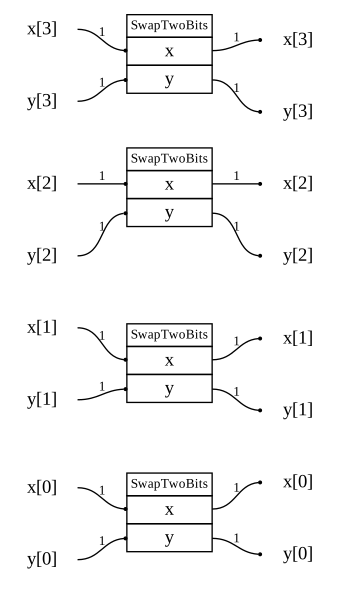
The problem is now we (once again) have a Python object constructed for each bit:
show_bloq(SwapManyBits(n=4))
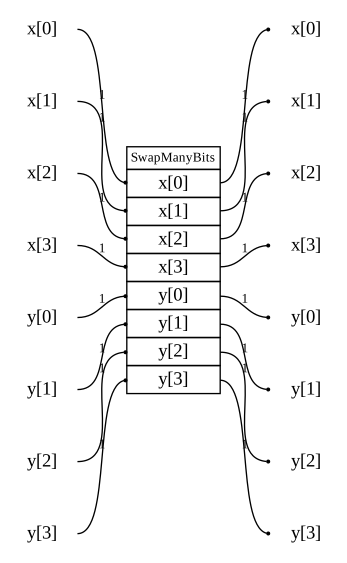
Can we have the best of both worlds? Yes: the general technique is to represent the Bloq
definition in as high-level terms as practical and use bb.split(...) and bb.join(...)
to break apart registers during decomposition. This way a user can use the Bloq as a black-box
without incurring the performance overhead of representing each bit if they do not care about
the decomposition. If they are interested in the decomposition, then the cost will only be
paid when actually doing the decomposition.
@attrs.frozen
class Swap(Bloq):
    n: int

    @property
    def signature(self):
        return Signature.build(x=self.n, y=self.n)

    def build_composite_bloq(
            self, bb: BloqBuilder, *, x: SoquetT, y: SoquetT
    ) -> Dict[str, SoquetT]:
        xs = bb.split(x)
        ys = bb.split(y)

        for i in range(self.n):
            xs[i], ys[i] = bb.add(SwapTwoBits(), x=xs[i], y=ys[i])
        return {
            'x': bb.join(xs),
            'y': bb.join(ys),
        }
cbloq = Swap(n=5).decompose_bloq()
show_bloq(cbloq)
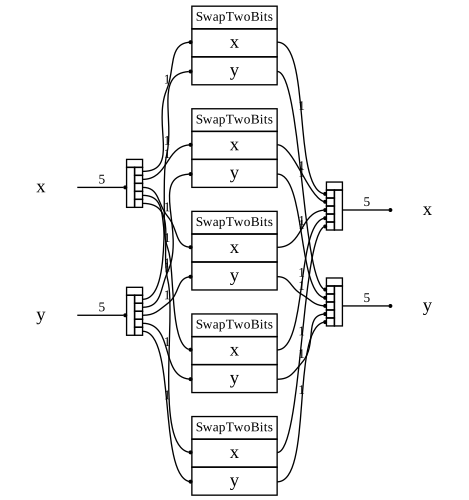
The interleaved wires can get a little confusing. An alternative method of visualization via the familiar “musical score” diagram is also available
from qualtran.drawing import get_musical_score_data, draw_musical_score
msd = get_musical_score_data(cbloq)
fig, ax = draw_musical_score(msd)
fig.set_figwidth(9)

Allocations and de-allocations#
We can encode operations that allocate and/or de-allocate quantum data as well. Each Register has an attribute called side. By default, it is set to THRU meaning that the quantum data moves through the register and that register is available for use as both an input and an output.
reg = Register('ctrl', QBit())
reg.side
<Side.THRU: 3>
LEFT and RIGHT#
We can declare registers that are input-only (“LEFT”) or output-only (“RIGHT”). Pure-state quantum evolution is unitary; so using registers like these implies you’re encoding a non-unitary operation. For example: bloqs which allocate a new qubit or discard an existing qubit would have asymmetric registers.
from qualtran import Side

@attrs.frozen
class ReAlloc(Bloq):
    @property
    def signature(self):
        return Signature([
            Register('input_only', QBit(), side=Side.LEFT),
            Register('output_only', QBit(), side=Side.RIGHT),
        ])

show_bloq(ReAlloc())
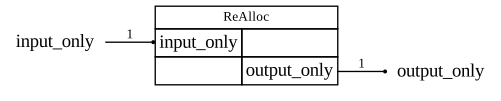
Of course, the signature only provides the side of the register. It is up to the bloq author to give it functionality by providing a decomposition or annotating it with simulation information. We’ll use the State and Effect one-qubit bloqs provided by the library to explore their behavior under simulation.
from qualtran.bloqs.basic_gates import ZeroState

# Show a simple allocating bloq and its tensor representation
show_bloq(ZeroState())
ZeroState().tensor_contract()
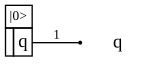
array([1.+0.j, 0.+0.j])
from qualtran.bloqs.basic_gates import PlusState, ZeroEffect

bb = BloqBuilder()

# Wire up <+|0>
q = bb.add(PlusState())
bb.add(ZeroEffect(), q=q)

# Show it and find its probability
cbloq = bb.finalize()
show_bloq(cbloq)
cbloq.tensor_contract() ** 2
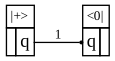
0.4999999999999999
Algorithms#
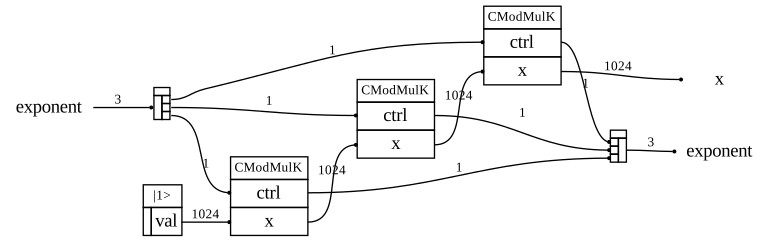
We’ve been looking at small, familiar bloqs to get acquainted with the functionality. Bloqs can represent quantum operations at any level of complexity, but are particularly useful for reasoning about high-level algorithms. For example, Qualtran includes a reference implementation of modular exponentiation (the limiting operation for Shor’s factoring)
from qualtran.bloqs.cryptography.rsa import ModExp

mod_exp = ModExp(base=8, mod=13*17, exp_bitsize=3, x_bitsize=1024)
show_bloq(mod_exp)
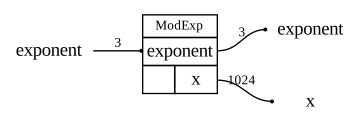
High-level bloqs should be defined in terms of only-slightly-less high-level bloqs to keep each step of the decomposition understandable. The ModExp bloq’s decomposition is:
def build_composite_bloq(self, bb: 'BloqBuilder', exponent: 'SoquetT') -> Dict[str, 'SoquetT']:
    x = bb.add(IntState(val=1, bitsize=self.x_bitsize))
    exponent = bb.split(exponent)

    # https://en.wikipedia.org/wiki/Modular_exponentiation#Right-to-left_binary_method
    base = self.base
    for j in range(self.exp_bitsize - 1, 0 - 1, -1):
        exponent[j], x = bb.add(self._CtrlModMul(k=base), ctrl=exponent[j], x=x)
        base = base * base % self.mod

    return {'exponent': bb.join(exponent), 'x': x}
In addition to decomposing and visualizing, we can use other protocols to query properties of the bloq or test its correctness.
show_bloq(mod_exp.decompose_bloq())