
The Call Graph Protocol#
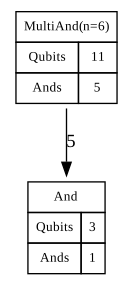
The call graph protocol lets you query which subbloq are called in a bloq’s decomposition. Proper accounting of the quantity of subroutine calls is a crucial tool in estimating resource requirements for an algorithm. For example, the number of ‘expensive’ gates like TGate or Toffoli required by a bloq is the sum of the number of those gates used by the bloq’s callees.
from qualtran.drawing import show_call_graph, show_counts_sigma
from qualtran.bloqs.mcmt import MultiAnd, And

bloq = MultiAnd(cvs=(1,)*6)
show_call_graph(bloq)
Interface#
The primary method for accessing the call graph of a bloq is Bloq.call_graph(). It returns a networkx graph as well as an accounting of total bloq counts for “leaf” bloqs.
graph, sigma = bloq.call_graph()
print(graph)
DiGraph with 2 nodes and 1 edges
Another method is Bloq.bloq_counts, which will return a dictionary of immediate children.
And().bloq_counts()
{}
These methods both take a generalizer argument.
Often, bloqs have attributes that are important for describing their specific action but don’t affect the bloq’s resource cost. For example, Rx(0.12) and Rx(0.13) should probably be considered equal when counting the number of operations. Another example is given below where we group all two-bit And operations no matter their control values.
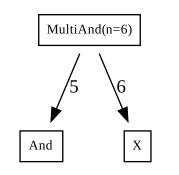
The generalizer argument is an optional callable that takes specific bloqs to general bloqs. In the next cell, we build a call graph with non-homogenous control values for MultiAnd which results in two different nodes for two-bit And showing up in the call-graph.
graph, sigma = MultiAnd(cvs=(1,0)*3).call_graph()
show_call_graph(graph)
show_counts_sigma(sigma)
Counts totals:
And: 5X: 6
This level of detail might not be relevant for your particular research. Below, we define a generalize function that replaces all control values with placeholder symbol values.
from qualtran.resource_counting import SympySymbolAllocator
import attrs

ssa = SympySymbolAllocator()
cv1 = ssa.new_symbol('cv1')
cv2 = ssa.new_symbol('cv2')

def ignore_cv(bloq):
    if isinstance(bloq, And):
        return attrs.evolve(bloq, cv1=cv1, cv2=cv2)

    return bloq

graph, sigma = MultiAnd(cvs=(1,0)*3).call_graph(generalizer=ignore_cv)
show_call_graph(graph)
show_counts_sigma(sigma)
Counts totals:
And: 5X: 6
We no longer have a specific clifford count (it has been replaced with O(1)), but we have a much simpler graph topology.
Additional functionality#
The qualtran.resource_counting module provides the functionality for building and manipulating call graphs.
Implementation#
The call graph functionality relies on the Bloq.build_call_graph(...) method to implement the protocol. This is where a given bloq’s callees is actually encoded.
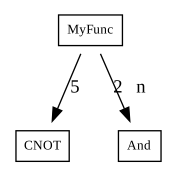
Bloq authors may want to override this method. The system will provide a SympySymbolAllocator when calling this method to assist with symbolic resource estimates. Below, we sketch out a bloq with custom bloq counts.
from functools import cached_property
from typing import Dict, Optional, Set, Union

from attrs import frozen

from qualtran import Bloq, BloqBuilder, Register, Side, Signature, SoquetT
from qualtran.resource_counting import BloqCountT, SympySymbolAllocator

import sympy

from qualtran.bloqs.basic_gates import CNOT

@frozen
class MyFunc(Bloq):
    n: Union[int, sympy.Expr]

    @cached_property
    def signature(self) -> 'Signature':
        return Signature.build(x=self.n)

    def build_call_graph(self, ssa: 'SympySymbolAllocator') -> Set['BloqCountT']:
        return {
            (And(), 2*self.n),
            (CNOT(), 5),
        }
myfunc = MyFunc(n=sympy.sympify('n'))
graph, sigma = myfunc.call_graph()
show_call_graph(graph)
Default Fallback#
If a bloq does not override build_call_graph(...), the default fallback will be used by Qualtran to support the call graph protocol.
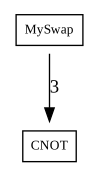
By default, Qualtran will extract the call graph from the full decomposition. For example, below we author a SWAP bloq. We define a decomposition but do not explicitly override build_call_graph.
@frozen
class MySwap(Bloq):

    @cached_property
    def signature(self) -> 'Signature':
        return Signature.build(q0=1, q1=1)

    def build_composite_bloq(self, bb, q0, q1):
        q0, q1 = bb.add(CNOT(), ctrl=q0, target=q1)
        q1, q0 = bb.add(CNOT(), ctrl=q1, target=q0)
        q0, q1 = bb.add(CNOT(), ctrl=q0, target=q1)
        return {'q0': q0, 'q1': q1}
The system will simply decompose the bloq and count up the children.
graph, sigma = MySwap().call_graph()
show_call_graph(graph)
show_counts_sigma(sigma)
Counts totals:
CNOT: 3
Testing#
qlt_testing.check_equivalent_bloq_example_counts is used to automatically compare manually-annotated counts against those derived from the bloq’s decomposition. If they match, the check returns PASS. If there is only one source of bloq counts, the check returns UNVERIFIED. If there are no bloq counts (either via annotation or decomposition), the check returns MISSING. If the bloq counts do not match, the check returns FAIL with more information about the mismatch.
BloqExamples have an optional generalizer attribute that this check will use during the comparison.
import qualtran.testing as qlt_testing
from qualtran.bloqs.mcmt.and_bloq import _multi_and as MULTI_AND_BLOQ_EXAMPLE

qlt_testing.check_equivalent_bloq_example_counts(MULTI_AND_BLOQ_EXAMPLE)
(<BloqCheckResult.PASS: 0>, '')