
Kikuchi Guiding State Tutorial#
import numpy as np
import sympy
from qualtran.drawing import show_bloq, show_call_graph
Let us start with a kXOR instance with \(n\) variables and \(m\) constraints.
from qualtran.bloqs.optimization.k_xor_sat.kxor_instance import KXorInstance

n, m, k = sympy.symbols("n m k", positive=True, integer=True)
inst = KXorInstance.symbolic(n, m, k)
inst
KXorInstance(n=n, k=k, constraints=HasLength(n=m), max_rhs=2)
We first prepare the guiding state to use in the guided sparse hamiltonian algorithm. The guiding state is defined by the instance, and a parameter \(\ell\) (a multiple of \(k\))
From Theorem 4.15 of the paper, this should be a circuit of \(O(\ell m \log n)\) gates, and prepare the state \(\beta |\Psi\rangle|0^{\ell \log \ell}\rangle + |\perp\rangle|1\rangle\), where \(\beta \ge 0.99 / \ell^{\ell/2}\).
from qualtran.bloqs.optimization.k_xor_sat.kikuchi_guiding_state import GuidingState

c = sympy.symbols("c", positive=True, integer=True)
l = c * k
guiding_state = GuidingState(inst, l)
show_call_graph(guiding_state.call_graph(max_depth=1)[0])

guiding_state_3 = GuidingState(inst, 3 * k)
show_bloq(guiding_state_3.decompose_bloq())
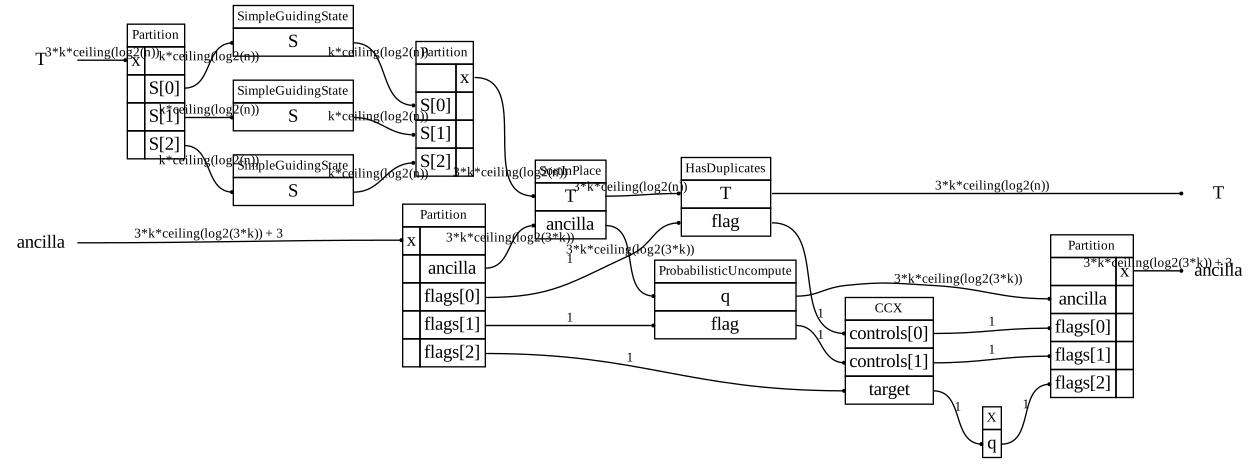
We can also build the guiding state for a concrete (non symbolic) instance:
inst = KXorInstance.random_instance(n=20, m=100, k=4, planted_advantage=0.8, rng=np.random.default_rng(100))
guiding_state_concrete = GuidingState(inst, ell=12)
show_bloq(guiding_state_concrete)
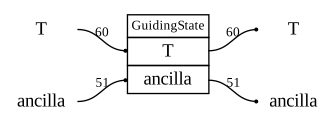
show_bloq(guiding_state_concrete.decompose_bloq())
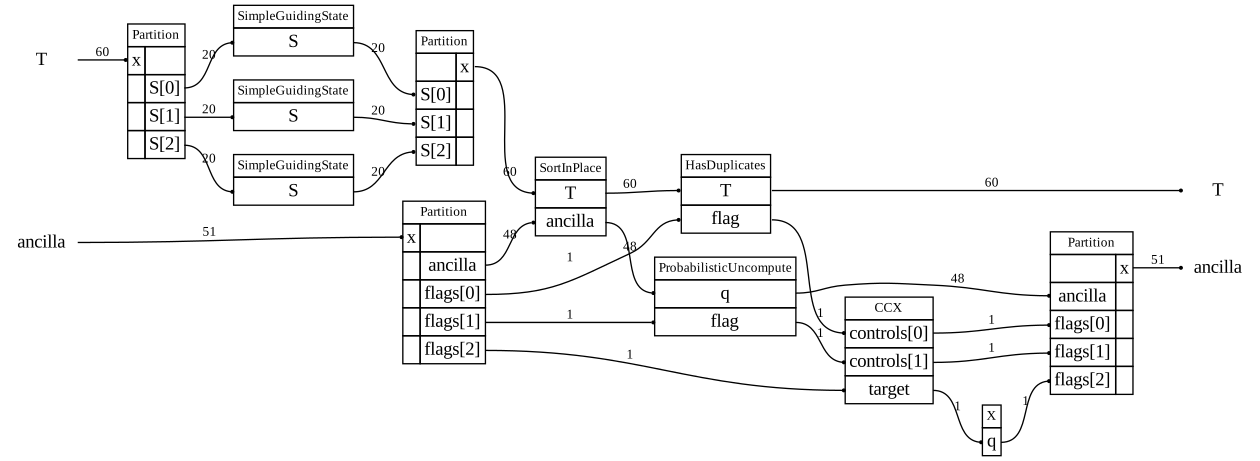
show_bloq(guiding_state_concrete.decompose_bloq().flatten_once())
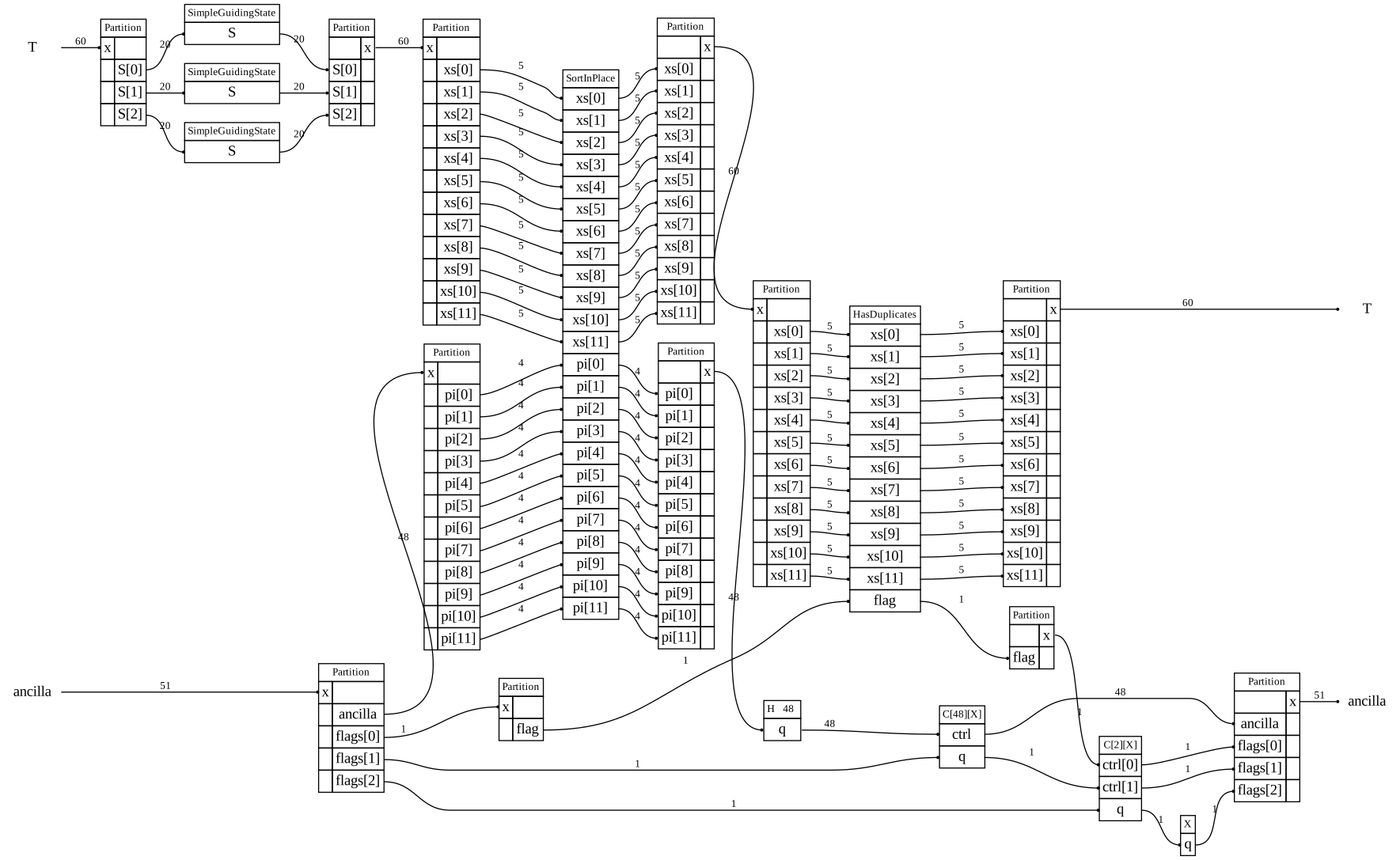
Let us evaluate the gate cost for the above bloqs.
from qualtran.resource_counting import get_cost_value, QECGatesCost

get_cost_value(guiding_state_concrete, QECGatesCost())
GateCounts(t=0, toffoli=552, cswap=4320, and_bloq=25175, clifford=170846, rotation=0, measurement=25175)
gc = get_cost_value(guiding_state, QECGatesCost())
t_cost = gc.total_t_count(ts_per_toffoli=4, ts_per_cswap=4, ts_per_and_bloq=4)
t_cost
from qualtran.symbolics import ceil, log2, floor
from qualtran.resource_counting import big_O

# simplify some expressions that sympy could not
klogn = k * ceil(log2(n))
klogn_long = ceil(log2(floor(2**klogn)))
t_cost = t_cost.subs(klogn_long, klogn)
t_cost = t_cost.simplify()

# replace l with a symbol
l_symb = sympy.symbols(r"\ell", positive=True, integer=True)
t_cost = t_cost.subs(c * k, l_symb)

big_O(t_cost) # matches paper Theorem 4.15 (as c, l are O(m))
show_call_graph(guiding_state_concrete, max_depth=3)
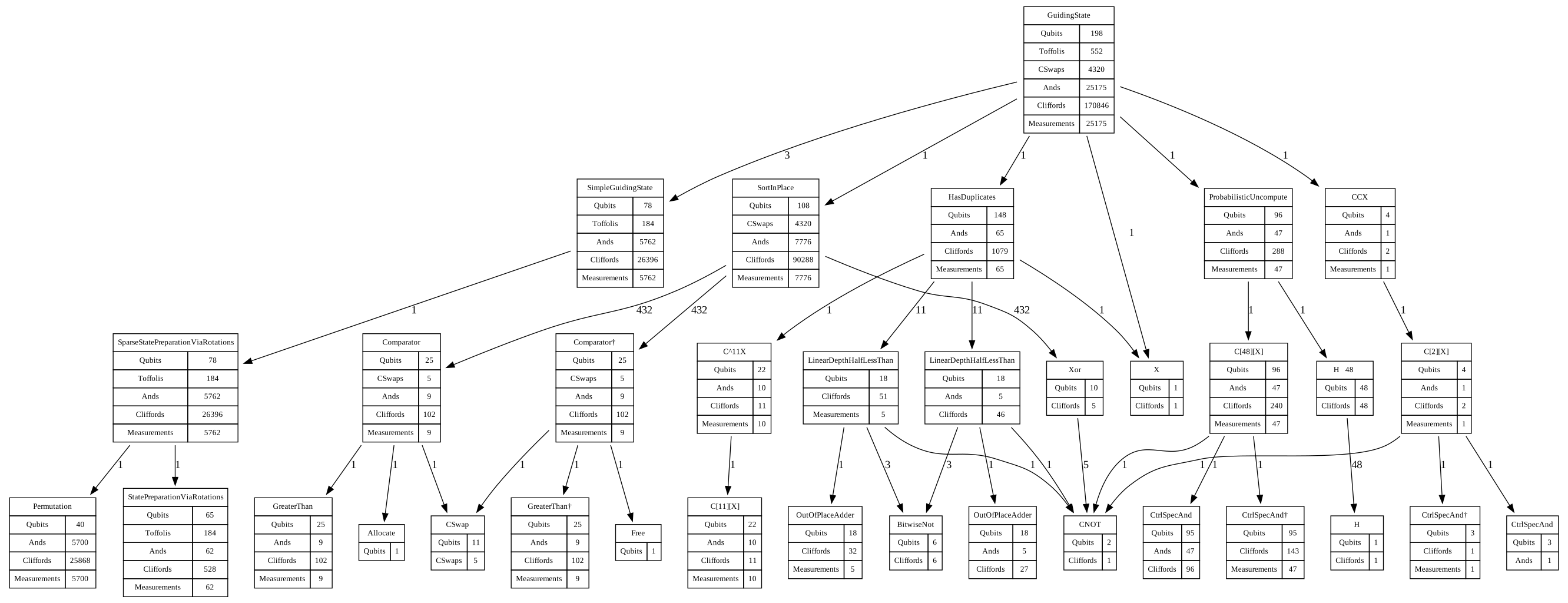
As we know that \(c = \ell/k \le \ell\) and \(\ell \le m\), the above expression matches the paper result of \(O(\ell m \log_2(n))\) 1/2-qubit gates.