
List Functions#
from qualtran import Bloq, CompositeBloq, BloqBuilder, Signature, Register
from qualtran import QBit, QInt, QUInt, QAny
from qualtran.drawing import show_bloq, show_call_graph, show_counts_sigma
from typing import *
import numpy as np
import sympy
import cirq
SortInPlace#
Sort a list of \(\ell\) numbers in place using \(\ell \log \ell\) ancilla bits.
Applies the map:
To apply this, we first use any sorting algorithm to output the sorted list in a clean register. And then use the following algorithm from Lemma 4.12 of Ref [1] that applies the map:
where \(x_i \in [n]\) and \(\pi(i) \in [l]\). This second algorithm (Lemma 4.12) has two steps, each with \(l^2\) comparisons:
compute
pi(1) ... pi(l)givenx_1 ... x_landx_{pi(1)} ... x{pi(l)}.(un)compute
x_{pi(1)} ... x{pi(l)}usingpi(1) ... pi(l)givenx_1 ... x_l.
Parameters#
l: number of elements in the listdtype: type of each element to store[n].
Registers#
input: the entire input as a single registerancilla: the generated (entangled) register storingpi.
References#
Quartic quantum speedups for planted inference. Lemma 4.12. Eq. 122.
from qualtran.bloqs.arithmetic.lists import SortInPlace
SymmetricDifference#
Given two sorted sets \(S, T\) of unique elements, compute their symmetric difference.
This accepts an integer n_diff, and marks a flag qubit if the symmetric difference
set is of size exactly n_diff. If the flag is marked (1), then the output of n_diff
numbers is the symmetric difference, otherwise it may be arbitrary.
Parameters#
n_lhs: number of elements in \(S\)n_rhs: number of elements in \(T\)n_diff: expected number of elements in the difference \(S \Delta T\).dtype: type of each element.
Registers#
S: list ofn_lhsnumbers.T: list ofn_rhsnumbers.diff: output register ofn_diffnumbers.flag: 1 if there are duplicates, 0 if all are unique.
References#
Quartic quantum speedups for planted inference. Theorem 4.17, proof para 3, page 38.
from qualtran.bloqs.arithmetic.lists import SymmetricDifference
Example Instances#
dtype = QUInt(4)
symm_diff = SymmetricDifference(n_lhs=4, n_rhs=2, n_diff=4, dtype=dtype)
Graphical Signature#
from qualtran.drawing import show_bloqs
show_bloqs([symm_diff],
           ['`symm_diff`'])
Call Graph#
from qualtran.resource_counting.generalizers import ignore_split_join
symm_diff_g, symm_diff_sigma = symm_diff.call_graph(max_depth=1, generalizer=ignore_split_join)
show_call_graph(symm_diff_g)
show_counts_sigma(symm_diff_sigma)

Counts totals:
BitonicMerge: 1BitonicMerge†: 1CNOT: 1EqualsAConstant: 1EqualsAConstant†: 1Equals: 5Equals†: 5HammingWeightCompute: 1HammingWeightCompute†: 1Xor: 4
HasDuplicates#
Given a sorted list of l numbers, check if it contains any duplicates.
Produces a single qubit which is 1 if there are duplicates, and 0 if all are disjoint.
It compares every adjacent pair, and therefore uses l - 1 comparisons.
It then uses a single MCX on l - 1 bits gate to compute the flag.
Parameters#
l: number of elements in the listdtype: type of each element to store[n].
Registers#
xs: a list oflregisters ofdtype.flag: single qubit. Value is flipped if the input list has duplicates, otherwise stays same.
References#
Quartic quantum speedups for planted inference. Lemma 4.12. Eq. 122.
from qualtran.bloqs.arithmetic.lists import HasDuplicates
Example Instances#
import sympy

n = sympy.Symbol("n")
has_duplicates_symb = HasDuplicates(4, QUInt(n))
has_duplicates = HasDuplicates(4, QUInt(3))
Graphical Signature#
from qualtran.drawing import show_bloqs
show_bloqs([has_duplicates_symb, has_duplicates],
           ['`has_duplicates_symb`', '`has_duplicates`'])
Call Graph#
from qualtran.resource_counting.generalizers import ignore_split_join
has_duplicates_symb_g, has_duplicates_symb_sigma = has_duplicates_symb.call_graph(max_depth=1, generalizer=ignore_split_join)
show_call_graph(has_duplicates_symb_g)
show_counts_sigma(has_duplicates_symb_sigma)
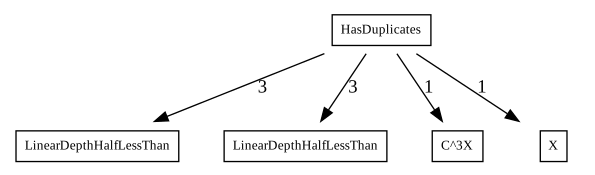
Counts totals:
C^3X: 1LinearDepthHalfLessThan: 3LinearDepthHalfLessThan: 3X: 1