
LCU Select/Prepare Oracles#
from qualtran import Bloq, CompositeBloq, BloqBuilder, Signature, Register
from qualtran import QBit, QInt, QUInt, QAny
from qualtran.drawing import show_bloq, show_call_graph, show_counts_sigma
from typing import *
import numpy as np
import sympy
import cirq
SelectBlockEncoding#
LCU based block encoding using SELECT and PREPARE oracles.
Builds the block encoding via
The Hamiltonian can be extracted via
where
The ancilla register is at least of size \(\log L\).
In our implementations we typically split the ancilla registers into selection registers (i.e. the \(l\) registers above) and junk registers which are extra qubits needed by state preparation but not controlled upon during SELECT.
Parameters#
select: The bloq implementing theSelectOracleinterface.prepare: The bloq implementing thePrepareOracleinterface.
Registers#
selection: The combined selection register.junk: Additional junk registers not prepared upon.system: The combined system register.
References#
Hamiltonian Simulation by Qubitization. Low et al. 2019. Sec 3.1, page 7 and 8 for high level overview and definitions. A block encoding is called a standard form encoding there.
The power of block-encoded matrix powers: improved regression techniques via faster Hamiltonian simulation. Chakraborty et al. 2018. Definition 3 page 8.
from qualtran.bloqs.block_encoding import SelectBlockEncoding
Example Instances#
from qualtran.bloqs.chemistry.hubbard_model.qubitization import PrepareHubbard, SelectHubbard

# 3x3 hubbard model U/t = 4
dim = 3
select = SelectHubbard(x_dim=dim, y_dim=dim)
U = 4
t = 1
prepare = PrepareHubbard(x_dim=dim, y_dim=dim, t=t, u=U)
select_block = SelectBlockEncoding(select=select, prepare=prepare)
from qualtran.bloqs.chemistry.hubbard_model.qubitization import PrepareHubbard, SelectHubbard
from qualtran.bloqs.multiplexers.black_box_select import BlackBoxSelect
from qualtran.bloqs.state_preparation.black_box_prepare import BlackBoxPrepare

# 3x3 hubbard model U/t = 4
dim = 3
select = SelectHubbard(x_dim=dim, y_dim=dim)
U = 4
t = 1
prepare = PrepareHubbard(x_dim=dim, y_dim=dim, t=t, u=U)
black_box_select_block = SelectBlockEncoding(
    select=BlackBoxSelect(select), prepare=BlackBoxPrepare(prepare)
)
Graphical Signature#
from qualtran.drawing import show_bloqs
show_bloqs([select_block, black_box_select_block],
           ['`select_block`', '`black_box_select_block`'])
Call Graph#
from qualtran.resource_counting.generalizers import ignore_split_join
select_block_g, select_block_sigma = select_block.call_graph(max_depth=1, generalizer=ignore_split_join)
show_call_graph(select_block_g)
show_counts_sigma(select_block_sigma)

Counts totals:
SelectHubbard(3, 3): 1
LCUBlockEncoding#
LCU based block encoding using SELECT and PREPARE oracles.
Builds the standard block encoding from an LCU as
The Hamiltonian can be extracted via
SelectBlockEncoding which uses Prepare for the signal state, while here
it is the identity operator.
The ancilla register is at least of size \(\log L\).
In our implementations we typically split the ancilla registers into selection registers (i.e. the \(l\) registers above) and junk registers which are extra qubits needed by state preparation but not controlled upon during SELECT.
Parameters#
select: The bloq implementing theSelectOracleinterface.prepare: The bloq implementing thePrepareOracleinterface.
Registers#
selection: The combined selection register.junk: Additional junk registers not prepared upon.system: The combined system register.
References#
Hamiltonian Simulation by Qubitization. Low et al. 2019. Sec 3.1, page 7 and 8 for high level overview and definitions. A block encoding is called a standard form encoding there.
The power of block-encoded matrix powers: improved regression techniques via faster Hamiltonian simulation. Chakraborty et al. 2018. Definition 3 page 8.
from qualtran.bloqs.block_encoding import LCUBlockEncoding
Example Instances#
from qualtran.bloqs.chemistry.hubbard_model.qubitization import PrepareHubbard, SelectHubbard

# 3x3 hubbard model U/t = 4
dim = 3
select = SelectHubbard(x_dim=dim, y_dim=dim)
U = 4
t = 1
prepare = PrepareHubbard(x_dim=dim, y_dim=dim, t=t, u=U)
lcu_block = LCUBlockEncoding(select=select, prepare=prepare)
from qualtran.bloqs.chemistry.hubbard_model.qubitization import PrepareHubbard, SelectHubbard
from qualtran.bloqs.multiplexers.black_box_select import BlackBoxSelect
from qualtran.bloqs.state_preparation.black_box_prepare import BlackBoxPrepare

# 3x3 hubbard model U/t = 4
dim = 3
select = SelectHubbard(x_dim=dim, y_dim=dim)
U = 4
t = 1
prepare = PrepareHubbard(x_dim=dim, y_dim=dim, t=t, u=U)
black_box_lcu_block = LCUBlockEncoding(
    select=BlackBoxSelect(select), prepare=BlackBoxPrepare(prepare)
)
Graphical Signature#
from qualtran.drawing import show_bloqs
show_bloqs([lcu_block, black_box_lcu_block],
           ['`lcu_block`', '`black_box_lcu_block`'])
Call Graph#
from qualtran.resource_counting.generalizers import ignore_split_join
lcu_block_g, lcu_block_sigma = lcu_block.call_graph(max_depth=1, generalizer=ignore_split_join)
show_call_graph(lcu_block_g)
show_counts_sigma(lcu_block_sigma)
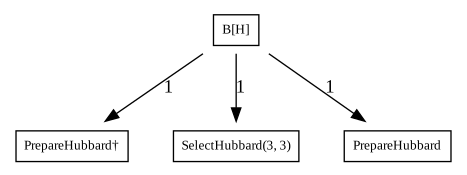
Counts totals:
PrepareHubbard: 1PrepareHubbard†: 1SelectHubbard(3, 3): 1
SelectOracle#
Abstract base class that defines the interface for a SELECT Oracle.
The action of a SELECT oracle on a selection register \(|l\rangle\) and target register \(|\Psi\rangle\) can be defined as:
In other words, the SELECT oracle applies \(l\)’th unitary \(U_l\) on the target register
\(|\Psi\rangle\) when the selection register stores integer \(l\).
from qualtran.bloqs.multiplexers.select_base import SelectOracle
PrepareOracle#
Abstract base class that defines the API for a PREPARE Oracle.
Given a set of coefficients \(\{c_0, c_1, ..., c_{N - 1}\}\), the PREPARE oracle is used to encode the coefficients as amplitudes of a state \(|\Psi\rangle = \sum_{l=0}^{N-1} \sqrt{\frac{c_l}{\lambda}} |l\rangle\) where \(\lambda = \sum_l |c_l|\), using a selection register \(|l\rangle\). In order to prepare such a state, the PREPARE circuit is also allowed to use a junk register that is entangled with selection register.
Thus, the action of a PREPARE circuit on an input state \(|0\rangle\) can be defined as:
from qualtran.bloqs.state_preparation.prepare_base import PrepareOracle
BlackBoxSelect#
A ‘black box’ Select bloq.
The SELECT operation applies the \(l\)’th unitary \(U_{l}\) on the system register
when the selection register stores integer \(l\).
When implementing specific SelectOracle bloqs, it is helpful to have multiple selection
registers each with semantic meaning. For example: you could have spatial or spin coordinates
on different, named registers. The SelectOracle interface encourages this. BlackBoxSelect
uses the properties on the SelectOracle interface to provide a “black box” view of a select
operation that just has a selection and system register.
During decomposition, this bloq will use the Partition utility bloq to partition
and route the parts of the unified selection register to the Select bloq.
Parameters#
select: The bloq implementing theSelectOracleinterface.
Registers#
selection: The combined selection registersystem: The combined system register
from qualtran.bloqs.multiplexers.black_box_select import BlackBoxSelect
Example Instances#
from qualtran.bloqs.chemistry.hubbard_model.qubitization import SelectHubbard

select = SelectHubbard(2, 2)
black_box_select = BlackBoxSelect(select=select)
Graphical Signature#
from qualtran.drawing import show_bloqs
show_bloqs([black_box_select],
           ['`black_box_select`'])
Call Graph#
from qualtran.resource_counting.generalizers import ignore_split_join
black_box_select_g, black_box_select_sigma = black_box_select.call_graph(max_depth=1, generalizer=ignore_split_join)
show_call_graph(black_box_select_g)
show_counts_sigma(black_box_select_sigma)

Counts totals:
SelectHubbard(2, 2): 1
BlackBoxPrepare#
Provide a black-box interface to Prepare bloqs.
This wrapper uses Partition to combine descriptive selection
registers into one register named “selection”.
Parameters#
prepare: The bloq following thePrepareinterface to wrap.
Registers#
selection: selection register.junk: Additional junk registers not prepared upon.
from qualtran.bloqs.state_preparation.black_box_prepare import BlackBoxPrepare
Example Instances#
from qualtran.bloqs.chemistry.hubbard_model.qubitization import PrepareHubbard

prepare = PrepareHubbard(2, 2, 1, 4)
black_box_prepare = BlackBoxPrepare(prepare=prepare)
Graphical Signature#
from qualtran.drawing import show_bloqs
show_bloqs([black_box_prepare],
           ['`black_box_prepare`'])
Call Graph#
from qualtran.resource_counting.generalizers import ignore_split_join
black_box_prepare_g, black_box_prepare_sigma = black_box_prepare.call_graph(max_depth=1, generalizer=ignore_split_join)
show_call_graph(black_box_prepare_g)
show_counts_sigma(black_box_prepare_sigma)

Counts totals:
PrepareHubbard: 1